

The company secretary plays a central role in maintaining statutory registers, managing corporate records, and tracking filing deadlines. When a company changes its secretary or corporate secretarial provider, a poorly managed handover can create a gap in responsibility, particularly between the outgoing secretary’s departure and the incoming secretary’s first review.
The risk is self-evident. If both parties assume the other is handling a particular filing, a filing deadline can be missed even when the company has otherwise maintained a clean compliance record.
This article explains when companies typically switch secretaries, what to prepare, how the handover works, and which controls can help prevent missed filings.
When Companies Decide to Switch
Companies typically change their company secretary for one of three reasons. Understanding the reason for the switch helps the incoming company secretary identify the most immediate priorities and address any outstanding matters effectively:
- Service issues: Late filings, unexplained penalties, or slow responses to routine queries may indicate that a change in company secretary is necessary. In some cases, these issues persist for an extended period before a missed deadline ultimately prompts the switch.
- Growth and complexity: Changes such as the admission of new shareholders, group restructuring, regional expansion, or plans for a public listing may require a higher level of corporate secretarial support than a provider serving a simpler corporate structure can offer.
- Cost and continuity: Companies may choose to consolidate their secretarial function with other corporate service providers to achieve greater efficiency. A change may also be required where an individual company secretary resigns, retires, or is otherwise unable to continue in the role.
Whatever the trigger, the switch itself need not give rise to compliance risks. A well-planned handover can address potential gaps before they develop into compliance issues.
What to Prepare Before the Handover
A smooth transition starts with ensuring that the necessary records and information are available and up to date. Preparing these materials before the handover provides the incoming secretary a clear understanding of the company’s current compliance position, governing practices, and upcoming obligations.
- Register inventory: Statutory registers, including the register of members, directors, charges, and registrable controllers should be complete, accurate, and readily available for review.
- Filing calendar: Key filing deadlines, including the next annual return and any other pending lodgements with the Accounting and Corporate Regulatory Authority (ACRA) should be identified and documented. This should include matters and filings already in progress with the outgoing secretary.
- Corporate records: The company’s business profile, constitutional documents, minutes and resolutions, statutory records, and relevant appointment and resignation documents including consent to act as director or company secretary should be organised and made available to the incoming secretary.
This preparation enables both parties to establish a clear understanding of what has been completed, what remains outstanding, and where responsibility sits on the handover date. Clear accountability at the point of transition helps reduce the risk of missed filings, overlooked obligations, and unnecessary compliance issues.
The Handover Steps and Statutory Filings
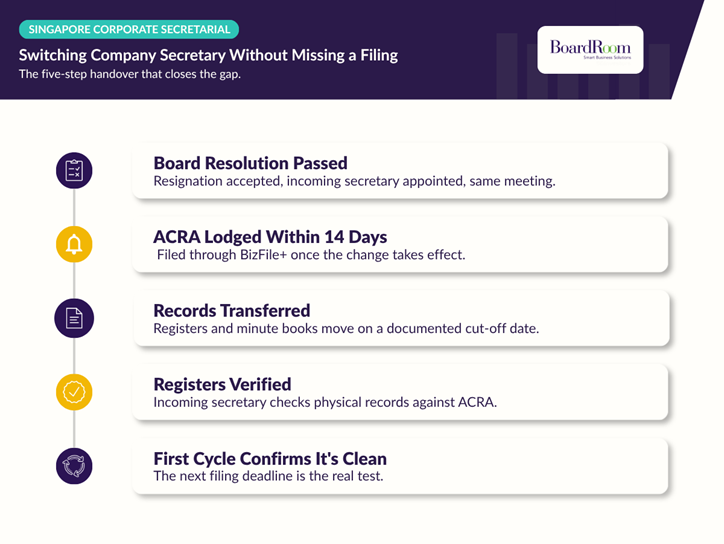
A company secretary transition involves both the formal change of appointment and the transfer of records, information and ongoing responsibilities. Careful coordination of these steps helps ensure continuity and minimise the risks of missed deadlines and compliance gaps:
- Board resolution: The board should accept the outgoing secretary’s resignation and approve the appointment of the incoming secretary, ideally at the same board meeting to ensure a seamless transition.
- ACRA lodgement: Changes relating to company officers, including the appointment or cessation of a company secretary, must be lodged with ACRA via BizFile+ within 14 days of the effective date of the change.
- Records transfer: Statutory registers, minute books, corporate records, and other records are transferred based on the agreed cut-off date. The scope of the handover and the date on which responsibility passes to the incoming company secretary should be clearly documented.
- Verification and reconciliation: The incoming secretary should review the company’s records against the information maintained by ACRA and identify any discrepancies, incomplete filings, or outstanding compliance matters requiring the follow.
A clearly documented handover process provides certainty on the allocation of responsibilities during the transition period. This helps ensure that ongoing filings, statutory deadlines, and governance obligations continue to be monitored and addressed without interruption.
Risks and Controls During the Transition
The period during a company secretary transition is often where accountability can become less clear. Three simple controls can help protect the company during this time:
- Clear ownership: Every filing or corporate action due during the transition period should have a named person responsible for completing it. This should be confirmed before the outgoing company secretary ends its engagement.
- Deadline verification: The incoming secretary should independently verify all upcoming filing deadlines and statutory obligations rather than relying solely on the information including outgoing company secretary’s calendar. This serves as an important safeguard against incomplete records and overlooked deadlines.
- Record reconciliation: Any discrepancies between the company’s statutory records and the information maintained by ACRA should be identified and resolved as part of the transition process, rather than being deferred until the next filing cycle.
The Singapore Companies Act 1967 requires every company to have at least one company secretary and provides that the office of company secretary must not remain vacant for more than six months. Accordingly, the outgoing company secretary’s cessation and the incoming company secretary’s appointment should be carefully coordinated to ensure continuity of oversight and minimise compliance risk.
A Realistic Timeline for a Smooth Transition
Most company secretary transitions follow a broadly similar pattern, although the timeline will depend on the quality, completeness, and accessibility of the company’s records.
- Preparation: Allow approximately one to two weeks to gather records, review statutory registers, reconcile outstanding matters, and identify upcoming filing obligations. Additional time may be needed if records are incomplete, inaccurate or outdated.
- Formal transition: Once responsibilities, records, and outstanding matters have been confirmed, the necessary board resolutions can be passed and the relevant changes lodged with ACRA.
- Stabilisation: Following the handover, the incoming secretary assumes responsibility for the compliance calendar and oversees the first reporting and filing cycle under the new arrangement. This helps identify any gaps and address any issues that may not have been apparent during the initial review.
While the exact timeline will vary from one company to another, the underlying principle remains the same. The more complete the records are before the transition, the smoother the transition and more effective the handover is likely to be.
A well-managed transition not only facilitates compliance continuity but also gives the incoming company secretary a solid foundation from which to support the company’s ongoing governance and regulatory obligations.
How BoardRoom Manages the Transition
BoardRoom’s corporate secretarial services are structured to minimise the compliance and operational risks that can arise during a company secretary transition:
- Structured onboarding: A review of statutory register, a documented cut-off date, and a verified filing calendar are established at the outset of the engagement, providing clarity on the company’s current position and upcoming obligations.
- Clear deadline ownership: Every filing due during and after the handover is assigned in writing before the transition takes effect.
- Integrated support: Corporate secretarial services are coordinated with accounting, tax, and share registry services where the company’s structure requires it.
A Clean Handover Keeps Compliance on Track
Transitioning to a new company secretary should not disrupt your compliance obligations. The key is to approach the transition as a structured handover, supported by complete records, clear accountability, and a verified filing calendar.
With the proper preparation, the incoming secretary can take over with a clear understanding of the company’s statutory records and upcoming filing obligations, reducing the risk of missed filings, incomplete filings, and unresolved discrepancies that could otherwise affect the company’s compliance position.
BoardRoom supports Singapore companies throughout the company secretarial transition process, from initial review of statutory records and handover planning to ongoing corporate secretarial and compliance management.
If you are considering a change of company secretary, BoardRoom can help assess your current arrangements, coordinate the handover process, and ensure a seamless transition with minimal disruption to your compliance obligations.
Contact BoardRoom to discuss your requirements and plan your transition.