
Restructuring has picked up across Singapore in 2026. Retrenchments rose from 3,830 in the first quarter to 4,500 in the second quarter, according to the Ministry of Manpower’s (MOM) advance estimates, with most attributed to business reorganisation or restructuring in sectors such as Information & Communications and Manufacturing.
Business closures have also increased. The Accounting and Corporate Regulatory Authority (ACRA) recorded 42,741 business cessations in the first eight months of 2026, 8.5% more than in the same period of 2025. When a restructuring or closure involves letting employees go, managing workforce transition lands on the payroll team.
This places significant time pressure on payroll teams. Final pay, notice, and benefit calculations must be accurate even when deadlines are tight, because an error becomes harder to fix once termination letters have been issued. A routine payroll error can be corrected in the next cycle, but a retrenchment error may not be discovered until after the employee has already left.
The reputational risk is just as high. Errors in final payments affect departing employees, while remaining staff will also notice how the process is handled. The exercise reflects how the organisation treats its people under pressure, not just whether the numbers are correct.
This article covers the employer obligations that apply during retrenchment, how to calculate final pay correctly, the statutory submissions that must not be missed, and where outsourced payroll support can reduce the risk of errors.
When Retrenchment Triggers Employer Obligations
Retrenchment is the dismissal of an employee due to redundancy or business reorganisation. It is distinct from termination for misconduct or resignation, and it matters because it determines which obligations apply and whether the employee may be entitled to a retrenchment benefit.
Employers should not characterise a redundancy as another form of termination simply to avoid retrenchment obligations. The circumstances surrounding the termination may be examined if the exercise is challenged.
These key obligations include:
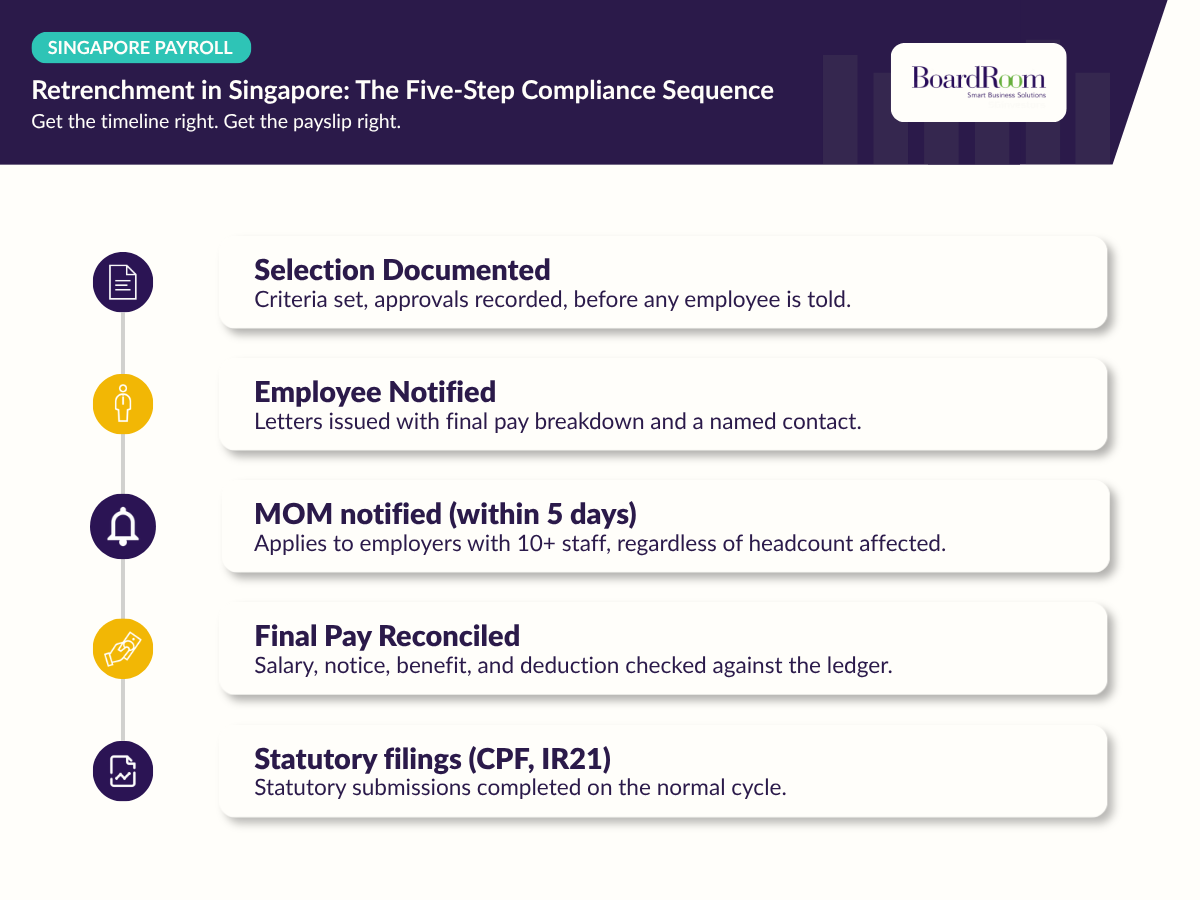
- Notification duties: Employers with at least 10 employees must notify the Ministry of Manpower (MOM) within five working days of informing affected employees of their retrenchment. This applies even if only one employee is affected. Employers with less than 10 employees are not required to but are strongly encouraged to notify MOM of retrenchment.
- Fair selection: Selection criteria should be objective, non-discriminatory, and based on factors such as the employee’s ability to contribute to the company’s future business needs. Employers should document the criteria before affected employees are notified, in line with the Tripartite Advisory on Managing Excess Manpower and Responsible Retrenchment.
- Maintaining a strong local core: Employers should take a long-term view of their manpower needs and ensure that retrenchment exercises do not disproportionately affect local employees. This is among the factors considered by MOM when reviewing retrenchment notifications.
Building the Final Payment Correctly
Final pay consists of several components, each with its own calculation and compliance requirements. Getting these right before payment is easier than fixing an incorrect settlement after the employee has left.
- Salary to the last day: This includes salary earned up to the employee’s last day of employment, unused annual leave, and any outstanding claims owed to the employee. MOM states that these salaries should be paid on the last day of work for retrenchment.
- Notice pay: The employer must either allow the employee to serve the required notice period or provide salary in lieu of notice, based on the applicable contractual notice period specified in the employment agreement.
- Retrenchment benefit: Employees who have served the company for at least 2 years are eligible for retrenchment benefit. Those with less than 2 years’ service could be granted an ex-gratia payment out of goodwill. The amount generally depends on the employment contract or collective agreement. MOM’s prevailing norm is between two weeks and one month’s salary for each year of service, depending on factors such as industry practice and the company’s financial position.
- Deductions: Only lawful deductions should be made, with each deduction properly supported and clearly itemised on the final payslip.
Statutory Submissions That Must Not Slip
Retrenchment does not put the normal compliance calendar on hold. Some obligations continue as usual, while others become particularly important when an employee leaves the organisation.
Three areas require close attention:
- Central Provident Fund (CPF): CPF contributions remain payable on salary and other components of final pay that qualify as wages. However, retrenchment or termination benefits themselves are generally not subject to CPF contributions.
- Tax clearance for non-Singapore citizens: Where tax clearance is required, employers must file Form IR21 with the Inland Revenue Authority of Singapore (IRAS) at least one month before the employee ceases employment. Moreover, employers should withhold monies due to the employee from the point the employer becomes aware of the impending cessation. This generally applies to employees who are not Singapore Citizens, including Singapore Permanent Residents, subject to applicable exemptions.
- Employment records: Employers must retain the required employment and salary records for the statutory period. For ex-employees, records must generally be kept for one year after the employee leaves, covering the latest two years of employment records. For tax and payroll purposes, records need to be kept for 5 years.
Payroll Documentation and Audit Trail
Accurate payroll records help employers explain final payment calculations, address employee queries, and resolve discrepancies that may arise after retrenchment. Maintaining a clear audit trail also makes it easier to trace adjustments and verify that payments were properly processed.
Employers should keep the following records for each affected employee:
- Supporting payroll records: Salary details, leave balances, contractual entitlements, and supporting documents for applicable benefits and deductions.
- Calculation and approval records: A breakdown of final pay calculations, including any adjustments made and the corresponding review and approval records.
- Payslips and payment confirmations: Itemised final payslips, payroll reports, and proof of payment to verify the amounts disbursed.
These records support the broader retrenchment process, which involves several compliance requirements and deadlines, as outlined below.
Why Companies Outsource Payroll During Restructuring
Restructuring places unusual pressure on payroll teams precisely when accuracy matters most. This is often when organisations reconsider whether the exercise should be managed entirely in-house or with specialist support:
- Capacity when pressure is highest: Internal teams may already be occupied with the wider restructuring exercise, while payroll accuracy still needs to be maintained.
- Specialist calculations: Notice pay, leave encashment, final-pay calculations, and IR21 processing can become more difficult when deadlines are tight, particularly for teams with limited experience handling retrenchments.
- Continuity: An external provider can keep payroll processing and compliance activities on track while the wider organisation is undergoing change, reducing the risk of missed deadlines or incomplete filings.
How BoardRoom Supports Employers Through Retrenchment
BoardRoom’s payroll services support employers through the retrenchment payroll cycle:
- Final pay processing: Calculation and disbursement of final pay, including salary, notice pay, leave and applicable benefits, with reconciliation before release.
- Statutory handling: Support with CPF submissions and IR21 tax clearance requirements, where applicable.
- Controls: Maker-checker review of final settlements before release, helping reduce the risk of errors reaching departing employees.
Getting Retrenchment Right From the Start
Retrenchment is both a payroll and compliance exercise, and it is conducted under scrutiny from employees, regulators, and other stakeholders. Preparation protects both the employer and the departing employee.
Getting notice, final pay, documentation, and statutory submissions right the first time is essential. A well-controlled process reduces the risk of disputes, missed deadlines, and payment errors at a time when the organisation is already under pressure.
BoardRoom supports Singaporean organisations by managing retrenchment payroll, handling statutory filings, and providing expert tax advisory and filing services for foreign nationals needing IR21 clearance.
Contact BoardRoom to discuss how specialist payroll and compliance support can help manage your restructuring exercise.