Great corporate governance starts with a skilled company secretary

Great corporate governance starts with a skilled company secretary Banner

Great corporate governance starts with a skilled company secretary

The COVID-19 pandemic altered the business landscape of marketplaces worldwide. Adapting to continual uncertainty and change has been necessary for survival. However, as we enter a new age of economic promise, Asia-Pacific enterprises are taking a proactive approach to corporate governance in order to assure a bright future for themselves and the larger economy.

In this article, Samantha Tai, Regional Managing Director for Corporate Secretarial, outlines the significance of corporate governance in Hong Kong. She further discusses how leaders may build values-based governance procedures in order to achieve outstanding results. In addition, we look at how the company secretary may advise and execute best-practice corporate governance measures to full effect.

What is corporate governance?

The meaning of corporate governance at the organisational level is to achieve superior performance, behave with integrity and maximise value to stakeholders. Companies that adhere to corporate governance norms are more likely to satisfy company goals, attract investment and outperform their rivals.

Significantly, the adoption of group-wide good corporate governance reduces the possibility of wrongdoing and consequent punishment.

In Hong Kong, the Prevention of Bribery Ordinance (POBO) sets out provisions for the prevention of bribery and for purposes thereto and connected therewith. Through the introduction of new code provisions under the Corporate Governance Code as set out in Appendix 14 to the Main Board Listing Rules and Appendix 15 to the GEM Listing Rules, that came into effect on 1 January 2022, all issuers have to establish an anti-corruption policy. For this reason, “companies need to make sure they have adequate procedures in place”, Samantha says.

Corporate governance is not a legal necessity for all Hong Kong enterprises, but Samantha believes that its link with fiduciary obligation makes it a crucial investment for every leader.

“We open BoardRoom training sessions in Malaysia by discussing a director’s fiduciary obligation to the Commonwealth to always prioritise the best interests of the firm, minimise conflicts of interest and act in good faith,” she explains.

“In Hong Kong, fiduciary obligation is taken very seriously, with authorities taking action against directors who fail to fulfil their responsibilities – including independent directors.”

Successful corporate governance frameworks include the creation of customised policies and their subsequent execution.

The corporate secretary is normally in charge of this duty.

Corporate Governance

The role of company secretaries in promoting corporate governance

Historically, the corporate secretary was a primarily administrative role and held minimal influence with the board. Today however, as a member of senior management and a statutory officer, the company secretary now handles various critical obligations for the organisation.

Company secretaries act as a connection between the board of directors, senior management and the company’s stakeholders (including regulatory bodies). This is in addition to their role in administrating crucial undertakings such as minutes taking, secretarial compliance and also company incorporation. Other duties include utilising digital technology, such as board management and ESG software, to strengthen board and shareholder procedures and improve corporate governance. Furthermore, because they are well-versed in local laws, they can guarantee that corporate governance standards are established, followed and evaluated on a regular basis.

The present responsibilities of the company secretary, according to Samantha, are clearly defined in the Corporate Governance Guide for Boards and Directors.

“In Hong Kong, the company secretary’s views on corporate governance are sought since they attend all board meetings, are familiar with relevant regulations and understand compliance needs,” she explains. “They advise the board on corporate governance practices that must be implemented. This might be related to the board’s structure or the company’s rules and code of ethics.”

They also assist publicly traded corporations in demonstrating corporate governance in their annual reports, including any alternative means utilised to attain the same goals.

Company secretarial responsibilities have become so synonymous with corporate governance that the Institute of Company Secretaries in the United Kingdom and the Institute of Chartered Secretaries and Administrators in Australia have both rebranded to the ‘Chartered Governance Institute’, with other regions expected to follow suit.

In Hong Kong, The Hong Kong Chartered Governance Institute unveiled its new brand identity in Jan 2022. Aiming to reflect its unique position and critical role as highly qualified experts in corporate governance in Hong Kong and the Mainland China, and as the China Division of the Chartered Governance Institute, an international organisation with nine Divisions globally.

Corporate Secretarial

How to elevate your corporate governance

Good corporate governance will become increasingly crucial in the coming years, with regulators anticipated to issue new guidelines for both public and private companies. Organisations that maintain best-practice standards as they develop will be well positioned to seize new opportunities and fulfil market needs.

You may lead your organisation to better corporate governance by implementing the actions outlined below.

1. Obtain the services of a qualified company secretary in Hong Kong

The first step toward better corporate governance is ensuring that your company follows existing standards and best practices, notably those outlined in the Hong Kong Stock Exchange Limited’s Corporate Governance Code. This includes assisting companies to adopt the new standards when they come into effect.

“Because they must report to the stock exchange, publicly traded firms already require corporate governance,” Samantha says. “However, they must now guarantee that corporate governance is practised in all of their subsidiaries as well – regardless of whether the subsidiaries are also listed firms or headquartered in Hong Kong or elsewhere.”

To meet this criterion, an experienced company secretary would assist in the development of a group-wide corporate governance structure. A code of conduct would be included, as well as rules and processes for corporate governance issues such as whistleblowing, anti-corruption, board diversity and sustainability.

Company secretarial service providers are a popular choice for executives who want to know that they will receive expert advice that is specific to their organisation.

    2. Develop detailed policies tailored to your needs

    Despite Hong Kong’s relatively high corporate governance performance, corporate irregularities can still occur. Failure to achieve expectations is sometimes attributed to internal perceptions of corporate governance as a box-ticking process, with the resulting policies being insufficient in length and content.

    Senior-level workloads can result in rapid copy-paste solutions.

    “Corporate governance involves more than simply copywriting,” Samantha cautions. “As there are many tools available, it’s important to bring your relevant management team together to discuss corporate governance framework development”.

    The most successful corporate governance policies:

    • are comprehensive;
    • represent the organisation’s values;
    • are appropriate for the organisation’s industry and size; and
    • outline how good governance is actively practised.

    3. Implement integrated reporting

    While it is critical to ensure that your corporate governance policies and yearly reports are up to date, effective governance cannot be accomplished simply with documentation. According to Samantha, integrated reporting will most likely become essential in the coming years.

    “Integrated reporting is a method based on integrated thinking that communicates how a company’s strategy, governance, performance and prospects lead to value generation,” Samantha explains. “It gives your yearly report more weight.”

    Rather than viewing reporting simply as a compliance exercise, embarking on an integrated reporting journey provides for improved employee engagement and value generation.

    Because all members of an organisation play a role in achieving good governance, it is equally critical to spend time articulating the importance of corporate governance to board members and personnel. You may do this by demonstrating how corporate governance standards are valuable instruments for improving business performance rather than arbitrary duties that must be completed.

    “Successful corporate governance is interwoven into the company’s day-to-day activities,” Samantha explains. “It’s not merely a compliance policy.”

    CS Reporting

    4. Develop a corporate culture that prioritises ESG

    Developing a corporate culture that prioritises Environmental, Social and Governance (ESG) can significantly elevate a company’s corporate governance. By integrating ESG considerations into business strategy, decision-making processes, and daily operations, you can demonstrate a solid commitment to ethical and responsible practices.

    According to Samantha, corporate governance issues are often overlooked by many CEOs due to their focus on navigating a challenging economy.

    Regulators are urging increasing board engagement in ESG efforts in the interests of top-down corporate governance, with country-specific compliance requirements changing on a regular basis. Board directors are better placed to account for ESG risks and make choices that increase shareholder value. As a result, more emphasis is placed on developing a complete ESG strategy that benefits not just the organisation, its shareholders and the environment but also its employees. This leads to long-term financial performance and value creation for all stakeholders.

    ESG

    Prioritise good corporate governance

    The strength of your corporate governance policies, practices and structures in the coming years will determine your business’s immediate and long-term prosperity.

    It is critical that your business’s board of directors and management team embrace its governance structure, but it is also critical that your company secretary steers its success. Choose a company secretary with diverse knowledge, strong ethics and exceptional communication skills for optimal results.

    Having an expert company secretary handle your corporate governance frees up your executive team to focus on other essential business objectives such as digital transformation.

    Contact BoardRoom’s corporate secretarial experts to learn how we can assist your company in meeting its corporate governance objectives.

    Contact BoardRoom for more information:

    Samantha Tai

    Samantha Tai

    Regional Managing Director, Corporate Secretarial

    E: [email protected]

    T: +852-2598 5234

    Related Business Insights

    Make the transition to outsourced accounting services to grow your business

    Make the transition to outsourced accounting services to grow your business

    If your firm intends to expand throughout the Asia-Pacific region (APAC), outsourced accounting services can help you achieve seamless business growth in an unpredictable economic climate.

    Given the complexities of the accounting function, it is common for business owners to be intimidated by the notion of hiring outside staff. In this article, we will look at how outsourcing can be used to create a smart business model and what actions you should take to guarantee a smooth transition.

    Why use outsourced accounting firms?

    Because of the numerous advantages of outsourcing accounting and bookkeeping, it is becoming a common alternative for APAC firms. In fact, according to a 2020 global study, over half of finance accounting professionals are contemplating outsourcing additional tasks.

    This can be attributed to three significant factors.

    1. Access to expert knowledge and skills

    Outsourcing gives businesses access to qualified professionals with a high degree of relevant knowledge and expertise – attributes that are not always simple to achieve through recruiting.

    “Companies frequently want to shift to outsourcing because they’re seeking specialists who can help them enhance their procedures,” says Yang Shuzhen, BoardRoom’s Accounting Director.

    Operational teams and managers are typically preoccupied with day-to-day operations, making it challenging to examine procedures objectively and discover opportunities for change. This is just one example of how an outside team might assist.

    “During COVID, many people working in Asia returned to their home countries, which has caused a shortage in the labour market,” Shuzhen notes. “Because of this, many APAC firms cannot source talent with the skills and experience they require.”

    2. Reliable and prompt service

    Accounting outsourcing provides immediate, practical support at a time when finance personnel turnover is rampant.

    “A lot of financial professionals want to take a break or try a totally new industry,” Shuzhen explains. “As a result, individuals are leaving, and in many cases, businesses cannot replace them at the same rate.”

    This can lead to insufficient handovers and employee shortages, causing transactions and procedures to fall between the cracks. Businesses confronted with these issues would consequently seek the assistance of an external provider with a pool of trained, professional accountants ready to analyse the situation and take over the processing.

    “They require experts who are experienced enough not just to take over their accounting duties but also to advise them moving ahead,” Shuzhen explains. “An external team can assist you in developing standard operating procedures and internal controls, both of which are essential for success.”

    Reliable and prompt service

    3. Digital transformation insights

    The accounting sector is undergoing significant development, with digital transformation providing opportunities to translate data into valuable business insights. The finance function is increasingly expected to contribute to the advancement of the strategic goals for a business in addition to executing transactional activities, which means that the required skill set for finance professionals is changing.

    According to A 2020 Deloitte study, finance’s new position as a strategic business partner would necessitate firms balancing human and machine-based skills while reflecting the four future-ready company qualities: analytical, adaptable, agile and anticipatory.

    The data analytics skills and technical experience necessary to do this can be challenging to maintain internally, which is why many organisations seek the assistance of premium outsourced accounting services.

    The COVID-19 pandemic has intensified outsourcing demand even further, with the global finance and accounting outsourcing industry predicted to reach USD 53.4 billion by 2026. This is mainly owing to a widespread demand for efficient solutions and stability in difficult times, which corporate services providers can deliver.

    Challenges faced by in-house accounting

    There are two primary reasons why APAC organisations are moving away from in-house accounting.

    Intensive labour is involved

    Recruiting, training and managing a finance team is time-consuming, as is expanding the team as your company grows.

    “A fast-growing organisation will devote a significant amount of money to educating the workforce, maintaining morale and ensuring the team functions properly,” Shuzhen explains. “This is significant because strong financials and timely reporting benefit the company when stakeholders make decisions.”

    However, resignations may be difficult for a team. Businesses may invest time in effective handovers and training for the new staff, but there will be a learning curve, so they will not have the same influence as the prior team. There is also no assurance that the workers will remain for an extended period.

    “Deliverables may be impacted when these changes become frequent and handover times are short,” Shuzhen warns.

    Technological changes are difficult to adapt

    Across APAC, digital innovation places pressure on internal teams to embrace new, more complex accounting systems.

    While this adaptability is necessary for continuous productivity, workforce constraints caused by the Great Resignation mean that there is frequently little time to guarantee new systems are implemented correctly. As a result, the new software may become a barrier rather than an aid, resulting in further delays and investment.

    An experienced accounting partner can efficiently negotiate with software providers to ensure that new systems are correctly customised to your firm. They can also plan a smooth and smart rollout of the new software, ensuring that the most critical solutions are installed first.

    How to outsource accounting services

    For a simple transition to outsourced accounting services in Hong Kong, we propose the following steps:

    1. Consider the accounting issues you are presently dealing with and the solutions you want to find through outsourcing.
    2. Examine the budget you have for accounting outsourcing.
    3. Get in touch with a reliable accounting services provider. They will meet with you to discuss your present position, assist you in gathering the essential information and advise you on the next steps.
    4. Inquire about the firm’s accounting software options to discover which is best for your company.

    A good provider will prioritise the critical tasks that require attention. Once things are under control, they will collaborate with you to develop a comprehensive end-to-end accounting solution for your company, as well as a tailored approach to advice.

    To set the initial onboarding and subsequent relationship up for success, evaluate who in your organisation is most suited to engage with them directly.

    The designated individual might be a finance manager, CEO, firm owner or director; the most essential thing is that they have extensive financial expertise and can discuss financial topics in depth. This will also assist in guaranteeing that the final solutions are matched to your specific requirements.

    Asian Accountant

    Making the right choice for your business

    Like an in-house team, your accounting services provider should integrate smoothly with your firm and have a deep awareness of your challenges. Your partner should deliver all the benefits of an in-house team while eliminating all the negatives. Once we have gained a deep understanding of your issues, we can provide all the benefits of an in-house team while removing the disadvantages.

    From accounts receivable and payments to general ledger and financial reporting, a full-service business can handle all areas of your accounting and bookkeeping. They will also be able to give business support in other areas, such as cash flow management, to assist your firm in meeting its objectives.

    “Our accounting solution at BoardRoom extends beyond transactional processing,” Shuzhen explains. “Financial data may be quite beneficial, and we utilise it extensively when advising our customers.”

    It is critical to seek an experienced accounting services provider since they can quickly and readily discover effective solutions to any accounting difficulties you may be experiencing. You will also know that the next time your firm is audited, it will have followed all of the proper protocols.

    Accounting outsourcing: what to avoid

    If you’re thinking about switching to accounting outsourcing, get started now.

    Businesses sometimes waste valuable resources attempting to handle accounting issues independently when an external services provider might have stepped in far earlier and implemented solutions in a much shorter time.

    Even if the organisation is small, financial commitments and difficulties can swiftly add up. So, if you are establishing a new organisation or branch in a neighbouring nation, it is important to hire an external team from the beginning to verify that the proper accounting processes are in place.

    The longer you put off outsourcing, the more difficult and time-consuming it can be to organise your finances and resolve problems.

    Outsource accounting services

    What are the benefits of outsourcing for business growth?

    If your firm has expansion plans, an accounting services provider might be a beneficial business partner.

    They can help you by:

    Offering thorough guidance and precise data at any time (so you can make quick decisions)
    Generating reports for possible investors
    Preparing financial ratios so you can have timely interactions with banks

    An accounting partner can also assist in establishing internal accounting controls at your headquarters and implementing these among finance units in other countries. Because you have identical internal controls throughout your regional sites, you can quickly generate reliable group-wide statistics at any time of year.

    Compliance with multi-country regulations

    Accounting partners also help businesses thrive by guaranteeing full regulatory compliance, including drafting and submitting statutory reports.

    In terms of your Hong Kong duties, an accounting partner will ensure that all your Hong Kong Financial Reporting requirements are completed and filed on time. Choosing a provider who supports multiple regions is crucial as other APAC areas will have distinct regulatory regimes, some of which may be quite rigorous and complicated.

    They can also ensure that your business is achieving its local compliance obligations on an ongoing basis by consolidating taxes with a worldwide organisation.

    Begin your transition to outsourcing your accounting services

    An expert accounting team working in close partnership with your internal team is critical to ensuring a smooth and lucrative trajectory, regardless of where you are in your expansion journey.

    Please contact us to learn more about BoardRoom’s world-class accounting and bookkeeping services, as well as our complementary payroll outsourcing and tax advisory solutions.

    Related Business Insights

    Hong Kong 2023-24 Budget

    HK Budget 2023-24 image

    Hong Kong 2023-24 Budget

    As Hong Kong enters the post-pandemic era, the Hong Kong 2023-24 Budget laid out the plans and measures for pursuing economic growth, moving to high‑quality development and enhancing people’s quality of life. We’ve outlined the key changes that you’ll need to be aware of, in order to optimise the benefits for your business.

    To find out how the tax measures announced will implicate your tax planning, download our Hong Kong 2023-24 Budget Report.

    If you have any questions relating to the information contained in this report or require tax advisory services, please contact our tax advisors via email or call us at +65 6536 5355.

    To view this report in Traditional Chinese, click here.

    To view this report in Simplified Chinese, click here.

    Related Business Insights

    The evolving role of company secretaries in Hong Kong

    The evolving role of company secretaries in Hong Kong

    The evolving role of company secretaries in Hong Kong

    Traditionally, a company secretary’s duties were restricted to simple administrative activities like filing annual returns, taking minutes, amending company constitutions and other in-house office tasks. However, the position is changing as corporate governance and company management become more important and sophisticated.

    In contemporary Hong Kong, the company secretary is a high-level position with a wide variety of significant responsibilities across several business areas. As a result, the company secretary plays a key part in supporting an organisation to realise its full potential.

    Read on as we examine the changing responsibilities of a company secretary, and the ways a capable company secretary can give your company a competitive edge.

    What is the importance of a company secretary?

    Company secretaries perform a range of tasks to assist with the operations of an organisation, but crucially, they ensure strict adherence to the Companies Ordinance and other local rules.

    Do not undervalue what a knowledgeable company secretary can bring to your business, especially if you are aiming to prosper in competitive markets. They will be able to assist in improving your governance procedures so that advantages and performance are maximised.

    Services provided by company secretaries include:

    • improving the structure of your company;
    • championing the creation of a robust environmental, social and governance (ESG) strategy;
    • ensuring your business meets its legal and regulatory obligations; and
    • establishing modern corporate governance procedures.

    The company secretary serves as a level-headed advisor, ensuring your business pursues its objectives with tenacity and honesty.

    Corporate Secretary

    What do company secretaries do?

    Within the Asia-Pacific (APAC) region, there are different laws and expectations governing company secretarial matters. After incorporation, companies in Hong Kong are required by law to select a company secretary.

    Standard responsibilities for company secretaries in Hong Kong include:

    Taking part in board conferences
    Arranging annual general meetings
    Communicating with directors and shareholders
    Maintaining secretarial records and statutory registers
    Drafting and submitting annual returns and other statutory returns with the Companies Registry
    Certifying documents with local authorities
    Managing the change of corporate structure
    Carrying out ad hoc tasks on the board’s behalf

    Company secretaries provide assistance throughout the business lifecycle, from setting up and maintaining a company in Hong Kong, business expansion across Asia Pacific, restructuring the company and even closing down the company.

    In what ways has the company secretary role changed?

    Company secretaries once had a relatively administrative role, but today they are extremely knowledgeable about the fast changing regional rules and regulations and high standards of corporate governance. As a result, they have adopted an advisory role within businesses: directors and shareholders are able to consult the company secretary for guidance on how to navigate compliance and corporate governance issues.

    Current areas of focus for company secretaries include advising the board on matters pertaining to ESG and statutory compliance.

    ESG advisory

    Businesses in Hong Kong are under building pressure to exhibit good governance as demand for strong ESG grows among investors, regulators and consumers. A 2020 KPMG survey revealed that sustainability reporting across APAC has increased from 78–84% since 2017.

    The company secretary has a significant role to play in advancing ESG because of their extensive involvement in both the operations and board activities of an organisation.

    Company secretaries help elevate initiatives by:

    • assisting with the development of ESG measures (such as whistleblower protection policies)
    • collaborating with sustainability team members to respond to ESG opportunities and risks;
    • setting up routine ESG auditing; and
    • assisting with accurate ESG reporting in company publications.

    Statutory compliance

    One of the company secretary’s primary duties is to remain aware of statutory requirements and provide updates to the relevant stakeholders. Directors and management teams must be able to consult the company secretary for accurate compliance advice, though the company secretary is not held responsible for legal decisions.

    Additionally, company secretaries help ensure the business is prepared for regulatory change.

    Some ways company secretaries assist with statutory compliance include:

    • scheduling proceedings of board and shareholder meetings;
    • drafting resolutions for the board and shareholders;
    • ensuring all required returns are submitted on time to the Inland Revenue Department Companies Registry and other government authorities;
    • helping any listed businesses comply with the Listing Rules for HKEX; and
    • providing training and updates on regulatory changes to directors and the relevant stakeholders.

    A skilled company secretary can deliver customised compliance solutions that meet regulatory criteria.

    Key obstacles in company secretarial services

    When appointing a company secretary, look for strong adaptability and excellent communication abilities. They will need these qualities to navigate compliance-related difficulties.

    Here are the top three obstacles company secretaries encounter.

    1. Keeping across evolving regulations

    Maintaining organisational compliance amid shifting regulatory environments is the primary challenge company secretaries face. One way they promote continuous compliance is by collaborating directly with authorities.

    Company secretaries provide a crucial link between businesses and regulators. They are able to assist with internal forward planning because, at times, they are aware of the proposed regulatory changes before the changes come into force.

    This prevents the need to rush the formalities to accommodate compliance with the new rules and regulations when the changes take effect.

      2. Implementing customised compliance solutions

      Every company’s compliance structure will be unique, taking into account the company’s corporate value, mission, size, location, industry, and listing status. The ability to create specialised business solutions for an organisation in accordance with its charter, within the constraints of the Companies Ordinance, is thus a requirement for company secretaries.

      A tailored compliance framework can help a company run ethically while still excelling in its sector.

      3. Securing buy-in among stakeholders

      Some companies fail to recognise the benefits of hiring a highly qualified company secretary. This is typically due to a weak compliance culture, where compliance is considered a burdensome task rather than a promising way to progress business objectives.

      Generally, the company secretary is in charge of directing secretarial compliance at all levels of a business. It is their responsibility to help shareholders, directors and staff understand:

      • the reason statutory, regulatory and corporate requirements are in effect;
      • why it is important for the business to meet these requirements; and
      • how strong compliance benefits the business and its people.

      Selecting a company secretary that takes compliance very seriously will help ensure your business maintains strict adherence to local regulations.

      Corporate Secretary

      Appoint a company secretary you can rely on

      Many businesses decide to partner with a respected corporate services provider for support with streamlining their operations. Along with corporate secretarial services, these can include help with accounting and payroll or share registry and employee stock ownership plans (ESOP). With this strategy, executive members of staff can pay more attention to business growth and worry less about compliance requirements. This provides greater opportunity to increase your production levels, effectiveness and profitability.

      By engaging a third-party secretarial service provider, you can also:

        Ensure the incorporation of your business is expertly handled
        Streamline secretarial compliance across multiple regions
        Maintain multi-country compliance through a single point of contact
        Receive crucial advice to support business expansion
        Minimise resource expenditure through a decreased administrative load
        Channel more resources into progressing core goals

        If your company intends to grow throughout APAC, you need to be ready for the various regulations and cultural expectations of each region. In addition, you will need to meet the legal requirements for any cross-border partnerships you enter into.

        Your business runs the risk of being fined for not meeting its compliance duties if your company secretary lacks the right credentials, abilities or attitude to ensure effective corporate governance.

        Be aware that if you engage corporate advisory services in individual regions, the complexity of your operations may increase. Seek a provider with offices throughout APAC to simplify your company compliance processes.

        Corporate Secretary

        Maintain competitive advantage

        If your goal is to expand successfully throughout APAC, BoardRoom specialises in a range of corporate services to suit your business needs. Our company secretary Hong Kong team are highly qualified with extensive experience in secretarial compliance matters, so they are able to provide valuable guidance at each stage of your growth journey.

        Chat with our specialists today to learn more about working with a capable corporate secretarial service provider.

        Related Business Insights

        How to take a strategic approach to regulatory compliance in Hong Kong

        How to take a strategic approach to regulatory compliance in Hong Kong

        How to take a strategic approach to regulatory compliance in Hong Kong

        For long-term business success and credibility, regulatory compliance is crucial. But shifting regulatory landscapes pose a significant challenge to Asia-Pacific (APAC) businesses looking to grow throughout the region. Modern multi-country companies must ensure their compliance frameworks address the specific mandates and expectations of each jurisdiction in which they operate.

        In this article, BoardRoom’s Group Director, Legal & Compliance Ai Min Lim and Hong Kong Compliance Director Davis Lau explain how businesses can take strategic action to ensure their compliance practices are aligned with the expectations of regulators, clients and partners. We will also explore the importance of building an internal compliance culture and choosing business partners that share your vision for strong compliance.

        Regulatory requirements in the Asia-Pacific region

        Following recent high-profile financial crime cases and the economic disruption of COVID-19, regulators across APAC are under mounting pressure to promote good governance and fair competition in their respective economies. Compliance requirements continue to change, making adaptability crucial for businesses operating across borders.

        “The regulatory landscape is evolving, with companies now facing escalating regulatory demands,” says Davis Lau.

        The main types of compliance

        In the Hong Kong business world, compliance can be broken down into the following three categories:

        Statutory compliance

        The local laws or ‘ordinances’ that companies must fulfil to operate their businesses (eg. anti-money laundering laws)

        Regulatory compliance

        The standards and rules that govern how laws are enforced (these are enforced by administrative bodies and often have the same force as laws)

        Corporate compliance

        Good governance practices that are strongly encouraged by regulators but not required under law or regulation.

        To continue operating and avoid penalisation, companies must comply with all relevant statutory and regulatory compliance requirements. However, the Hong Kong compliance agenda is now evolving beyond basic compliance to incorporate broader strategic issues, prevalent within the third category – corporate compliance.

        Companies that take a holistic approach to compliance by pursuing all of the above categories with equal dedication will earn increased trust from their stakeholders, leading to greater competitive advantage.

        Strategic compliance starts at the top

        Strategic compliance

        Taking a strategic approach to regulatory compliance will ensure your business not only meets but exceeds its governance goals. According to Ai Min Lim, one key strategy is to make sure your company’s compliance efforts start from the top.

        “Management must recognise that they have to put resources into compliance and invest in it, because it’s not just ‘good to have’ — it’s absolutely crucial to protect the business,” she says.

        Compliance cannot be driven by the Compliance Department (or equivalent) alone. It is the responsibility of the management team to set the tone and ensure that compliance is part of the company culture. The importance of compliance and the messaging around it must cascade down to staff across all levels to ensure uniform practice across the organisation.

        Every member of an organisation, from the mailroom to the boardroom, needs to work together to achieve compliance. It is not just a process or policy on paper, but something that is operationalised and its importance understood at all levels of the organisation.

        Build a culture of compliance

        To create a compliance program that goes beyond ‘checking the boxes’, leaders need to start dismantling outdated perceptions of compliance as a burden.

        Corporate workers are generally very busy with competing priorities. So with changes to regulations having a direct impact on day-to-day processes, it can be challenging for people to see compliance as a valuable part of business.

        Key ways to cultivate an appreciation of regulatory compliance include:

        Showing workers how compliance fundamentally makes their jobs easier
        Appointing compliance champions in each business unit
        Fostering two-way dialogue between employees and compliance officers/champions (eg. via support channels and Q&A sessions)

        Once you have secured buy-in from all staff, your company’s risk of misconduct and subsequent penalisation will dramatically reduce.

        Common challenges of compliance

        All businesses in Hong Kong, no matter their size or industry, face similar obstacles in the pursuit of regulatory compliance. As the first step towards your compliance vision, it is important to identify these common challenges and explore how they might impact your organisation.

        Keeping up with evolving requirements

        According to a 2022 Regulatory Outlook report by Deloitte, the changeable nature of corporate rules across APAC means it will be increasingly difficult for organisations to maintain standard internal controls and processes. Relying on regulatory compliance management software alone is no longer an option.

        For example, a new inspection regime is coming into effect under the Companies Ordinance for Protecting Personal Information. The mandatory regime applies to Hong Kong companies and registered non-Hong Kong companies (including listed companies) that must now take a number of time-sensitive actions to meet the new requirements.

        To maintain ongoing compliance, companies must predict how emerging regulations may impact not only their compliance processes but also their business models and strategic direction. On top of this, they must correctly interpret the meaning of new laws, which are often expressed in complicated legal speak.

        There is no one-size-fits-all approach

        With local requirements varying greatly depending on the size, industry and location of your business, compliance is usually not a straightforward task.

        “Compliance for a startup and compliance for a multinational corporation are very different concepts,” says Davis. This means there’s no single framework, roadmap or workflow tool available to make compliance easier. Its nuanced nature requires a tailored solution.

        Fortunately, Hong Kong recognises that companies require some flexibility to implement the best governance practices to suit their circumstances. For example, while publicly listed companies are expected to comply with the Corporate Governance Code, they are allowed to deviate as long as they can provide considered reasoning in their annual report.

        One-size-fits-all approach

        How to stay across regulatory changes

        Stay across regulatory changes

        From setting the vision, devising the strategies, providing relevant training and then reporting on results, regulatory compliance requires significant resources to be effective.

        Partnering with experienced providers across all business endeavours takes the guesswork out of responding to complex rules and regulations. Ultimately helping your staff understand their directive and potential implications. Plus, they can help you make strategic compliance decisions that align with changes in corporate governance and other regional-level activities.

        Start implementing strategic regulatory compliance today

        Strategic regulatory compliance benefits your business in several crucial ways. It protects you from reputational damage and hefty fines and promotes positive relationships with key stakeholders (including customers, staff and regulators) that will propel your business towards its goals.

        Contact us to speak with a local expert about regulatory compliance in your organisation.

        Related Business Insights

        Why multinationals are consolidating their taxes with one provider

        Why multinationals are consolidating their taxes with one provider

        Why multinationals are consolidating their taxes with one provider

        When it comes to business operations, tax and accounting are two of the most vital and complicated responsibilities. Mistakes in these areas can have serious legal repercussions, so they need to be handled with a high level of accuracy. On top of this, companies that conduct business in multiple Asia-Pacific jurisdictions need to comply with all applicable local legislation – a complex task.

        In Deloitte’s 2021 Asia Pacific Tax Complexity Survey, 80% of respondents said the region’s tax systems are more intricate now than they were in 2018.

        Many tax and accounting professionals aspire to engage a full-service business tax advisory firm in Hong Kong, China, Malaysia or Singapore to coordinate all their accounts in each region. However, not all businesses take this option, especially if they have expanded rapidly or are new to the region.

        In many cases, organisations begin a new tax management partnership each time they branch into a new country. It is a common occurrence, with service providers offering thorough knowledge of local tax rules and regulations. But managing multiple tax advisors can be difficult.

        It is not unusual for tax professionals in multi-country businesses to come up against:

        • Complicated cross-border tax implications and treaties: different statutory and regulatory compliance requirements can cause delays, confusion and penalty.
        • Communication problems: variations in language and culture can make it hard to harmonise the activities of multiple tax partners.
        • Staff attrition: staff turnover is increasing due to the great resignation.
        • Technology differences: cross-border operations can be difficult due to regional differences in technology and communication.

        Is your business facing these challenges? You may benefit from consolidating your tax management with a business tax advisory service in Hong Kong, China, Malaysia or Singapore. Wherever your company is based, an experienced tax services firm will provide you with a single point of contact, making multi-country tax coordination simple.

        Read on to discover the benefits of consolidating your taxes with one provider as well as tips on choosing an appropriate partner for your business.

        Local expertise is invaluable

        Asia-Pacific governments regularly enact new corporate rules and regulations, and companies must stay across the changing tax regimes of each country they operate in.

        An experienced tax advisor can help you satisfy all local obligations while successfully managing multi-country operations. The tax rules in Hong Kong can be particularly tricky to navigate, so the advice of a knowledgeable service provider is invaluable.

        Tax breaks and exemptions can easily go unnoticed if you lack access to local expertise. Outsourcing your accounting and compliance functions to a third party professional will ensure your company applies for all tax benefits and incentives it is entitled to.

        Seeking a reputable tax firm in Hong Kong that has solid connections in neighbouring regions will ensure your cross-border operations are executed with professionalism and accuracy, while meeting all statutory obligations.

        Effective communication

        Prior to selecting a tax partner, find out whether you will have one point of contact or need to communicate with multiple individuals in different regional offices. The second arrangement is undesirable, as you would need to navigate all the same issues that come with in-house tax administration.

        The best business tax advisory firms connect clients with a network of tax experts via one contact point. This scenario provides you with access to quality tax advice and services without the problems that come with coordinating multiple teams.

        Communication

        The advantages of working with one unified team can also have significant financial rewards. Tax benefits and incentives are maximised across your business while errors, discrepancies and miscommunication amongst suppliers are reduced. Having one point of contact will also help you align your company goals on a global level, keeping consistency and reliability throughout your business.

        When handling tax across several countries, you also need to be mindful of cultural differences. The Asia-Pacific region encompasses a variety of cultures, traditions, religions and languages, so it is important to engage a trusted tax firm that can guide you through cross-border business with sensitivity and success.

        A highly trained international tax advisor in Hong Kong, China, Malaysia or Singapore will be able to help you adapt your working styles to suit specific Asia-Pacific locations.

        What is the meaning of tax compliance?

        Authorities across the Asia-Pacific region are paying closer attention to corporate tax activities as rules and regulations tighten. No business wishes for a tax compliance audit, so understanding tax compliance meaning is imperative. Finance and account staff are required to work harder with fewer resources as budgets and employee numbers decline. This adds pressure to your internal teams as they navigate Hong Kong tax compliance.

        A changing global workforce presents an additional challenge for businesses: teams and resources are frequently pushed thin as employees hunt for new jobs that offer better salaries or wellbeing programs.

        Regardless, legal obligations must be followed. Companies must strive to comply with Hong Kong’s strict statutory requirements by keeping up with all tax payments. Non-compliance can have severe legal consequences.

        Failure to comply can be due to a small mistake, such as overlooking a detail in statutory documents or miscalculating debts.

        Ensuring adherence to changing requirements can be extra difficult if your company has business partners across the Asia-Pacific region and the world.

        Compliance

        When you partner with an established third-party provider that understands local tax requirements in Hong Kong and throughout the wider Asia-Pacific region, your key decision-makers will have more availability to focus on company expansion. You can enjoy peace of mind, knowing that your tax administration is compliant with evolving local laws, as well as being reported correctly and on time.

        If any compliance concerns emerge, your tax partner will be able to respond quickly and capably.

        Top-tier service providers undertake a comprehensive analysis of your business structure, prior to giving advice on tax administration and future planning. This approach enables your teams to take advantage of tax benefits for your business in the long term.

        Selecting a premium tax advisor

        Handing over your tax administration to a reputable third-party provider will save you time and money: the efficiency of your teams will improve, increasing your profitability as a result.

        When it comes to taxes, cost considerations are crucial, but selecting the cheapest service provider is rarely a good move. A firm’s track record will provide a good indication of the kind of service you would receive.

        It is important to ask potential tax advisors questions like:

          How large is your client base?
          How long have you been running?
          What have you achieved in the years since you opened?
          What results have you delivered for clients?
          Do you operate in multiple regions?
          Can you support my business as it grows across borders?
          What is your staff retention like?
          Do you have many long-term employees?

          If the tax services firm you are considering provides confident, positive answers to these questions, it is a good sign their performance standards are high. You can have faith they will coordinate your taxes with skill, efficiency and professionalism.

          With sought-after providers like BoardRoom, you will enjoy:

          • High accuracy: BoardRoom has a strong 50-year history of reliable service and a reputation for quality.
          • Personalised service: due to low personnel turnover rates, we always have experts on hand to promptly and properly service your needs.
          • Superior knowledge: our highly trained professionals have an in-depth understanding of local legislative landscapes across the Asia-Pacific region.

          Branch out with confidence

          It is important to ensure your present tax activities are in check, but looking ahead to your business’s tax management in the years to come is just as crucial.

          Are you already operating in multiple countries across the Asia-Pacific region? If so, you may be planning to expand into additional regions. As part of your planning, be sure to factor in the extra statutory requirements and cultural nuances you will face.

          This is why global expertise is so important when it comes to selecting a specialist tax services provider.

          As an example, BoardRoom partners with Andersen Global, a network of tax and legal professionals operating in 315 locations worldwide. Our international relationships strengthen our knowledge of cross-border corporate taxation issues.

          Entrusting your taxes to an international provider guarantees you will have the specialised legal counsel you need to expand and prosper.

          The advantages of outsourcing multiple functions

          When comparing potential advisory firms, find out whether they are able to handle several business functions alongside tax.

          Company incorporation and corporate secretarial services are closely connected to tax management, and professional administration of these functions is necessary for successful expansion. Opting for a full-service firm will save you money and time, which allows you to channel more resources into growing your business and achieving your main goals.

          As businesses expand, efficiency becomes all the more important.

          Outsourcing

          Outsourcing several responsibilities to one service provider is a wise move because they already have a strong grasp of the way your business operates. They will be able to provide assistance in a range of capacities with very little hassle.

          Enhance productivity through consolidation

          Consolidating several corporate responsibilities with a single tax advisory firm has many benefits – particularly when you think about the money and time required to liaise with multiple firms throughout the region. You will enjoy significant yearly savings, especially if your partner can identify and apply for all the local tax breaks and incentives your company is entitled to.

          Premium tax outsourcing will lead to faster and smoother processes in many areas of your business.

          The task of tax administration only grows more complex. That is why engaging a skilled tax services provider is important to support your growth and ensure compliance with local statutory requirements as they evolve.

          Interested in consolidating your company’s tax functions with one service provider? Reach out to our tax team today.

          Related Business Insights

          Hong Kong 2022-23 Budget – Key Highlights on Tax and Business-Related Measures

          Hong Kong 2022-23 Budget

          Hong Kong 2022-23 Budget – Key Highlights on Tax and Business-Related Measures

          Delivered by the Financial Secretary, Mr Paul Chan, the Hong Kong 2022-23 Budget was announced on 23 February 2022. The expansionary budget was curated to provide immediate Covid-19 support to its people and businesses and to achieve future economic growth as the country battles with its fifth wave of COVID-19 outbreak.

          Some of the key highlights from this year’s budget includes new and extended personal and corporate tax incentives, business relief measures and long-term tax planning initiatives. As businesses make adjustments to their tax planning, BoardRoom has identified key highlights from the Hong Kong budget to help businesses minimise their tax charges and optimize their earnings.

          Download our Hong Kong Budget 2022-23 Report for a concise summary about how these implications might affect your corporate tax planning.

          If you have any questions relating to the information contained in this report or require tax advisory services, please contact our tax advisors via email or call us at +852-2598 5234

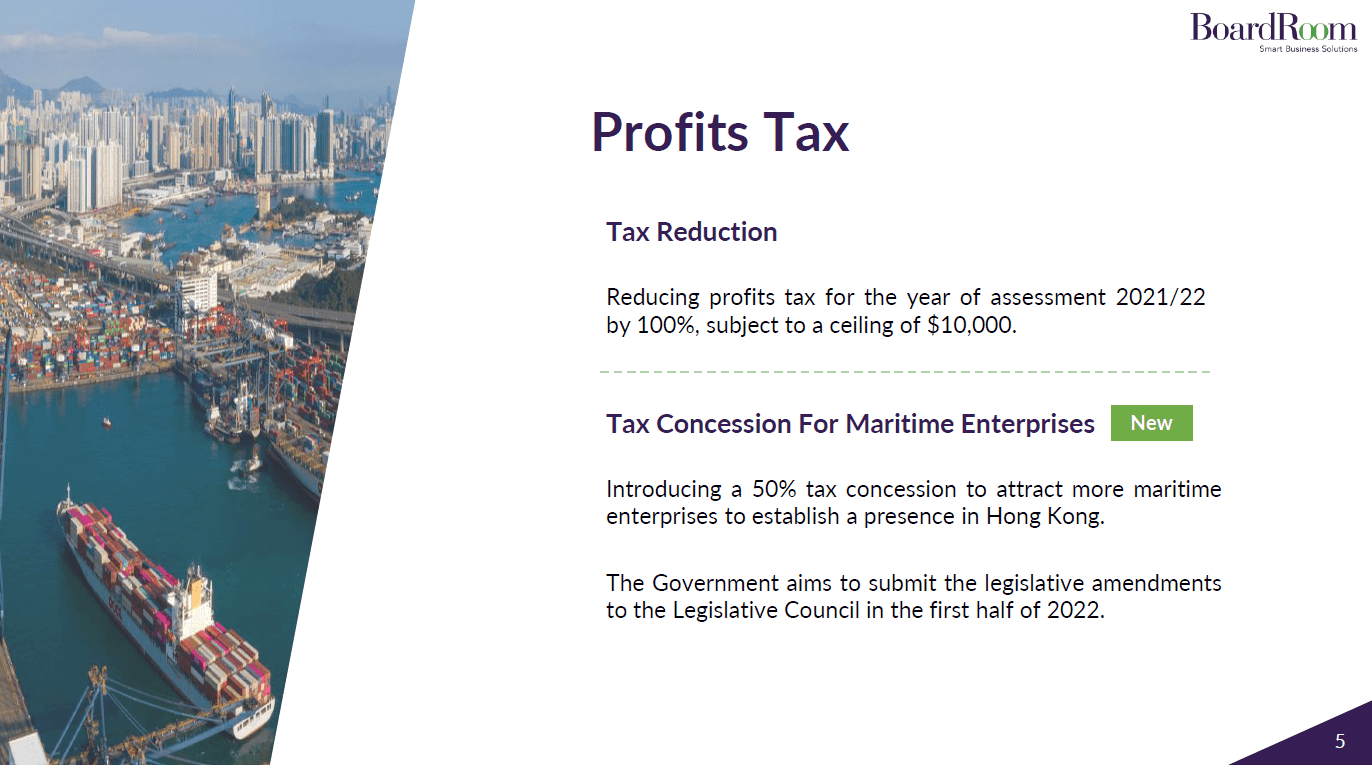
          Profit Tax
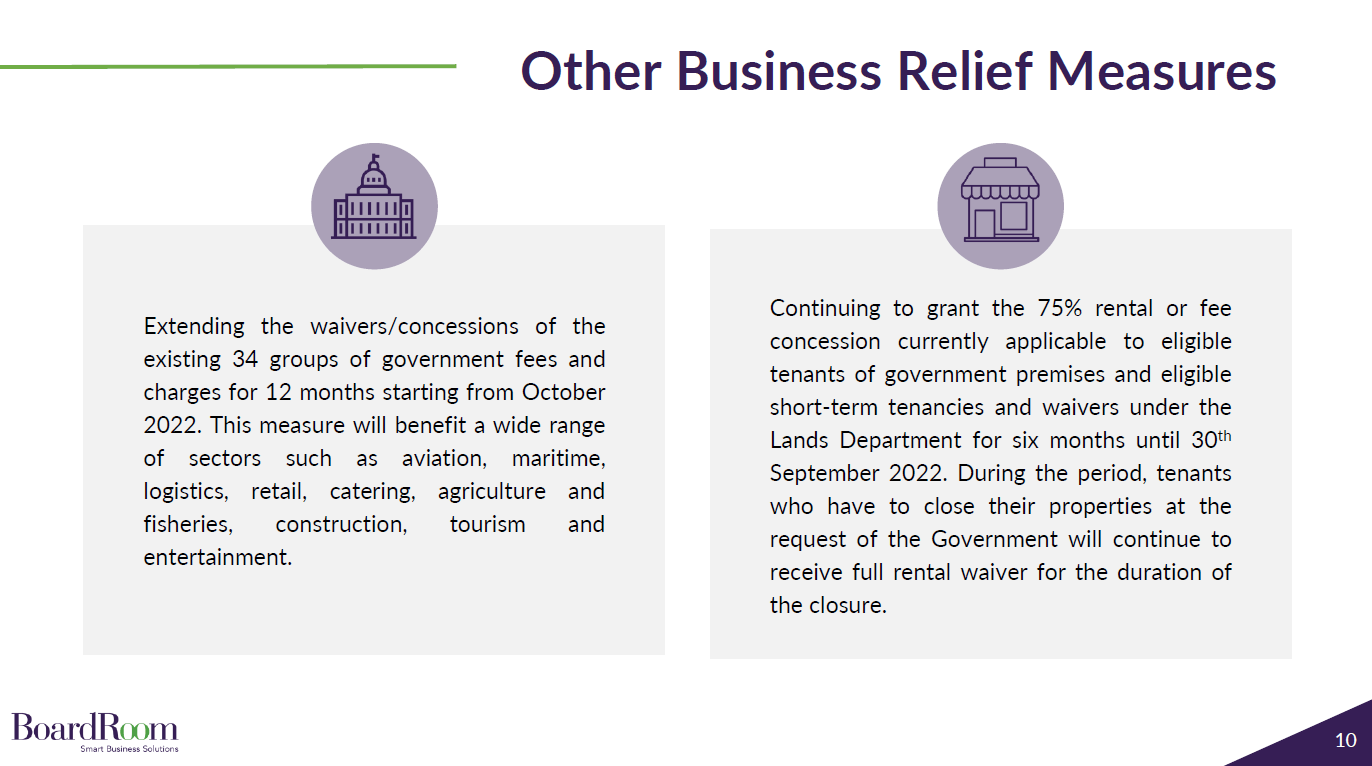
          Other Business Relief Measures
          business-relief-hong-kong-budget-2022
          Stamp Duty Wavier
          stamp-duty-hong-kong-budget-2022
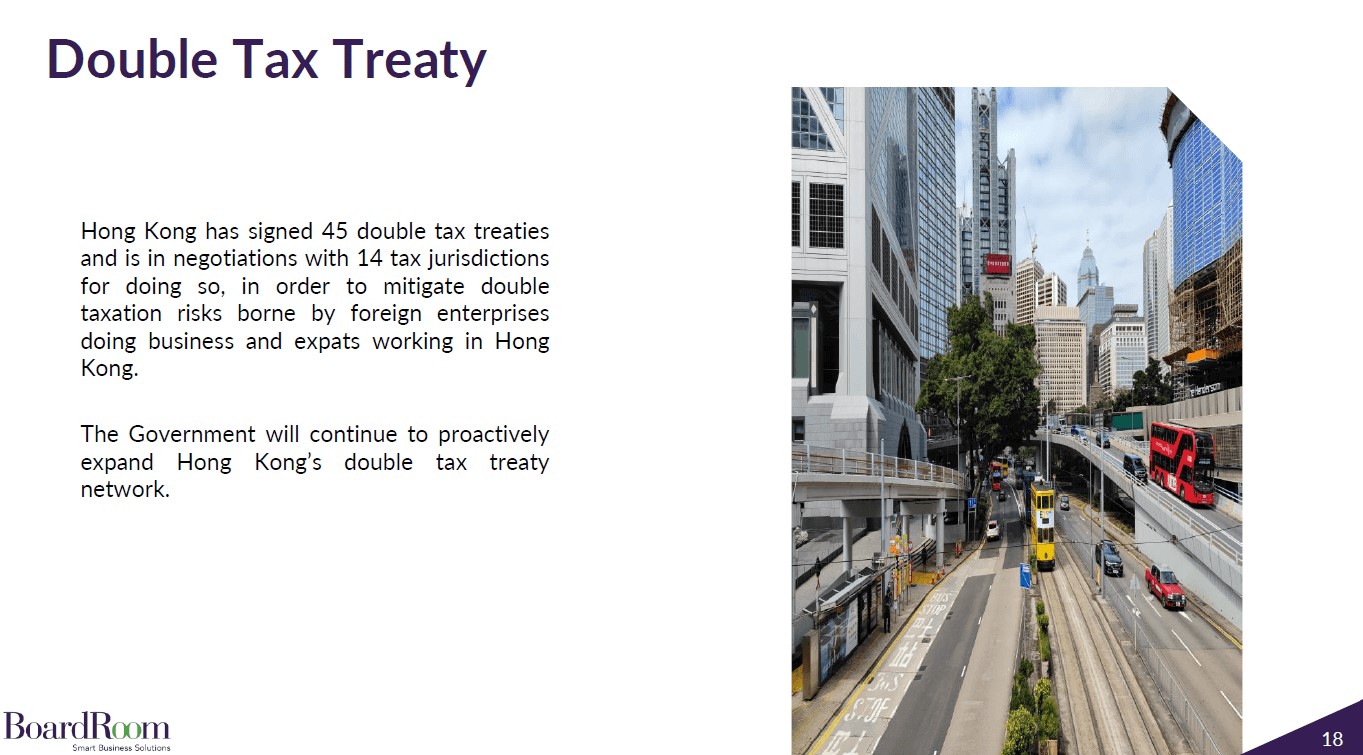
          Double Tax Treaty
          tax-treaty-hong-kong-budget-2022

          Related Business Insights

          Cloud Accounting with Xero and BoardRoom – Make it work for you

          Cloud accounting with Xero and BoardRoom

          Cloud Accounting with Xero and BoardRoom – Make it work for you

          Cloud Accounting with Xero and BoardRoom Hong Kong – Make it work for you

          Cloud accounting platforms like Xero are well recognised for their benefits such as saving time, money and effort for companies in Hong Kong – big and small. It can improve your finance team’s productivity and speed up processing of payments and invoices, which means your company is getting paid faster.

          Even so, there are still companies hesitant to make the switch from traditional accounting to a cloud accounting system.

          A common concern is the set up and migration of existing financial data into Xero which can be difficult, particularly so for companies with complex structures, or small businesses with fewer resources. This can make implementation time-consuming and hinder your company from realising the full benefits of Xero.

          The solution? By working with the right Xero partner like BoardRoom, your switch to Xero cloud accounting solution can be a seamless and rewarding experience. Our Xero online accounting experts in Hong Kong will advise and guide you through the process on how you can best optimise Xero to your benefits, effectively improving your accounting and business tools.

          Leave traditional accounting behind today

          Cloud accounting uses online software and stores the data from your accounts in the cloud. ‘The Cloud’ is a network of remote servers storing vast amounts of data. In contrast, traditional accounting software is installed locally on your computer with data stored on a hard drive or a server on-site.

          While traditional accounting has its benefits such as not requiring an internet connection and having full control over your security levels and access, it is heavily dependent on ensuring that updates and data backup are done continually. When in comparison, the benefits of cloud accounting far outweigh those of traditional accounting.

          Cloud accounting software makes it easier for your team to access and collaborate, all without the need for additional hardware costs and software expenses. It also offers your company a real-time snapshot of business performance while providing data security and protection. But perhaps the most important aspect for a business owner is that cloud accounting helps you save time and improve accuracy, which assists your company run more efficiently. This is why many companies in Hong Kong use cloud accounting, like Xero.

          Xero accounting implementation made easy with the right partner in Hong Kong

          The complexities of Hong Kong’s regulation make changing to a new accounting system challenging. However, with a team that’s experienced in implementing a new professional accounting system such as Xero for companies in Hong Kong, organisations can avoid potential pitfalls such as misplaced data or accidentally limiting essential user access.

          Finding the right affiliate can be as simple as looking at the partners that are certified as a Xero consultant. BoardRoom for one is a XeroTM Gold Champion Partner that has consistently showcase our expertise in implementing Xero for a wide range of company profiles.


          We’re experienced in transferring your company’s data from your existing accounting system to Xero. Once you have provided us with the necessary data, we will work in the background to set up your Xero file setup according to your needs. This means minimal downtime for your team while they continue working as per normal.

          Our support does not just end at set-up – we also ensure that your team is confident in fully optimising the Xero platform. This includes training and support services to facilitate the change management process for your team. Our Hong Kong team is also just an email, phone, or video conference call away to support your team with any Xero enquiries.

          Challenges of Xero set-up and migration for complex company structures

          Data migration and change in accounting platforms are especially tricky for companies with a complex structure. Strategic planning is often needed to ensure your company structure is reflected correctly in Xero and that it meets any regulatory reporting requirements in Hong Kong.

          Companies may risk errors, issues, and potentially expensive faults when switching accounting platforms. Improper set-up and migration of data may lead to long-term problems such as not being able to meet regulatory reporting requirements. Having a partner with the right qualifications like BoardRoom can help avoid these pitfalls and save you time further down the road.

          Our Xero data migration services ensure a complete data migration, comparative balances migration and porting over of last closing balances. Additionally, our online training modules will guide your team through purchase, sales, bank transactions and reconciliation, cash flow, inventory, sending online invoices, generating financial reports, in addition to other advanced features.

          accounting software

          Making Xero accounting right for your company in Hong Kong

          How do you get the most out of Xero accounting software, especially with limited resources? With thousands of apps and integration available on Xero, BoardRoom Hong Kong helps to cut out the guesswork by recommending the right ones that best suits your company needs.

          We also customise your chart of accounts or report templates, incorporate your logo into financial documents, or set-up tracking categories and contacts – plus more. Most importantly, we’ll provide the necessary training to ensure that your team is set towards success.

          Grow your business with BoardRoom’s regional expertise

          When you partner with BoardRoom, you’re not working with a regular accountancy firm. As professional services experts, we operate across multiple jurisdictions and offer a wealth of knowledge on all aspects of company administration. This means that no matter where your offices are located, whether Hong Kong, Singapore, Malaysia, China or Australia, we can assist you to seamlessly integrate all of your accounts functions and accounting services through your Xero accounting system.

          In addition to Xero set-up and migration, we also provide incorporation, share registry, company secretarial, payroll, plus many other administrative services. Therefore, by partnering with BoardRoom, your company gains access to our wide range of skills and expertise to assist your administration and accounts teams operate more efficiently.


          xero implementation partners

          Xero consultations are available for full scale migration, set-up, or integration of systems – such as payroll or point of sale. No matter the complexity of your company structure or which accounting system you’ve been using, our team of experts is always ready to provide support through every step of the way.

          Find out more today on how partnering with BoardRoom can save you time and money for your Xero implementation needs.

          Related Business Insights

          Hong Kong Corporate Tax Guide: Improve Your Tax Planning

          corporate tax planning

          Hong Kong Corporate Tax Guide: Improve Your Tax Planning

          Improve Your Tax Planning with our Hong Kong Corporate Tax Guide

          Hong Kong is world-renowned for its business-friendly taxation and regulatory environment, with corporate tax rates that are considered some of the lowest in Asia.

          However, some companies still pay more tax than they need to. Effective corporate tax planning maximises tax benefits while maintaining compliance. To help your company improve its tax planning, we have created a guide to corporate tax in Hong Kong.

          How to pay corporate tax in Hong Kong

          Corporate tax is known locally as ‘profits tax’ in Hong Kong. It applies to all profits (excluding capital asset sales) that are:

          • sourced in Hong Kong; and
          • generated by corporations, sole proprietors, partnerships, trustees and bodies of persons carrying on any trade, profession or business in Hong Kong.

          For corporate tax purposes, no distinction is made between resident and non-resident companies. This means no tax is levied on profits arising abroad, even if they are remitted to Hong Kong.

          The standard corporate tax rate is capped at 16.5% for corporations or 15% for unincorporated businesses in Hong Kong. However, a two-tiered corporate tax rates regime applies, which lowers the rate on the first HKD 2 million of assessable profits to:

          • 8.25% for corporations; or
          • 7.5% for unincorporated businesses.

          Assessable profits above HKD 2 million are subject to the standard profits tax rate.

          Typically, the Inland Revenue Department (IRD) issues profits tax returns annually on the first business day of April. After calculating how much tax your company owes, file your profits tax return within one month of the issue date (subject to any extension applications).

          When your company receives the IRD’s notice of assessment, you must pay a provisional tax. If your company ends up under- or overpaying your provisional profits tax, you can subtract or add the amount to your payable tax for the following year.

          business tax advisory

          Why business tax planning is important

          Tax planning is the process of examining your business’s financial situation and making strategic decisions to lower your overall tax liability. Effective corporate tax planning is all about analysing your company’s finances to ensure that you pay the lowest taxation possible while staying compliant with the local regulations in Hong Kong.

          There are many reasons why your Hong Kong business needs to prioritise tax planning. Perhaps the most obvious one is to save money. By carefully analysing your financial situation and taking advantage of every deduction and credit available to you, you can minimise your company’s overall taxation liability. This could result in thousands of dollars in savings for your business each year. In addition to saving money, there are additional reasons why tax planning is crucial for your company’s growth and success:


          • Avoid penalties and fines: If you underpay your corporate taxes under the wrong rates, you will be subject to late payment penalties, heavy fines, or even jail time from the Hong Kong government. These charges can add up quickly, so it’s important to ensure that you are paying the correct amount of taxes each year. A professional tax advisor can help you determine exactly how much taxes you owe so that you can get peace of mind and steer clear of these costly charges.


          • Improved cash flow: One of the key benefits of effective corporate tax planning is that it can free up cash flow for your business in Hong Kong. By deferring or reducing your taxes, you will have more cash available in the short-term to reinvest in your business or take care of other expenses. This could give your business the boost it needs to reach the next level of success.


          • Better understand your company’s finances: Many businesses make strategic decisions without fully understanding their financial situation. Proper tax planning can help you gain a better understanding of your company’s finances, which can be extremely helpful when making decisions about things like expanding into new markets outside of Hong Kong or investing in new product development. With this information at hand, you can make informed decisions about where to allocate your resources in order to maximise growth and profitability.

          How your company could benefit from expert business tax advisory services

          Tax planning amid Hong Kong’s complex tax regulations can be challenging. Without a specialised expert to guide you or provide corporate tax accounting support, it can be easy to miss out on tax breaks and exemptions that your business is entitled to. The best way to maximise your company’s savings and deductions is to work with professional accountants who understand Hong Kong’s regulations when navigating Hong Kong taxation and tax planning.

          Our tax experts at BoardRoom are not only well-versed in Hong Kong’s local tax regulations but also have in-depth knowledge of international tax treaties. With their advice, your organisation can avoid any double tax issues. Moreover, our team will help you to apply for any extra tax incentives that could benefit your business.

          Additionally, as your company grows, so too does the complexity of your tax reporting obligations. If you fail to meet your tax filing obligations, you may experience costly penalties. Our corporate tax accountants help guide countless businesses in all industries and sizes across Hong Kong and the APAC region to stay tax compliant each financial year.

          Looking for trusted tax advisory services in Hong Kong?

          With over 50 years of experience delivering top-notch corporate services, BoardRoom is your trusted business partner to help you take care of your bookkeeping and accounting needs so you can focus on growing your business. Contact our taxation specialists today to discover how they could guide your company through staying compliant with Hong Kong’s corporate tax regulations and maximising tax benefits.

          We also offer a range of other corporate services all under one roof, including:

          These make it easier for you to get on with business while we handle the time-consuming, operational tasks.

          Related Business Insights

          Setting up a company in Hong Kong: what you need to know

          Setting up a company in Hong Kong: what you need to know

          HOW TO: Setting up a company in Hong Kong

          Thinking of establishing a company in Hong Kong? Expanding into a new international market is exciting for any business, but it also presents its own set of significant challenges. For many executives, the first hurdle is understanding how the company formation regulations and processes work in the new jurisdiction. This includes the required permits and licenses, the legal and taxation requirements, and more. Not to mention, prior to setting up a company, you should also have a clear understanding of the business environment in Hong Kong as well as that of your specific market.

          While the company formation process may be complex, our guide below makes it easier to take the leap. Read on for a comprehensive overview of everything you need to know about setting up a company in Hong Kong.

          Hong Kong Market Profile

          Hong Kong is an important financial hub within the Asia Pacific (APAC) region that is renowned for its business-friendly taxation and regulatory environment, making it fertile ground for business setup. Some of the key characteristics of the Hong Kong market include:

          • Office rental pricing: Average monthly rent for grade A office space in Hong Kong’s central district was $HK 1,807 per square metre for the first quarter of 2021.
          • Average office space density: 1sq m per person
          • Fixed internet download speed: 59 megabits per second in July 2021
          • Mobile internet download speed: 06 megabits per second in July 2021
          • Gross Domestic Product US$ bn: 344.7
          • Population: 7.5 million
          • Official languages: Chinese, English
          setting up a company in hong kong

          Benefits of setting up a company in Hong Kong

          As one of the largest financial centres in Asia, Hong Kong offers many benefits to companies looking to set up a business and establish a presence in the region, including:

          • Strategic locational advantages: Hong Kong’s central location makes it an ideal destination for setting up a company that wants to enter the mainland Chinese market or expand its operations within the APAC region.

          The Hong Kong market also has many cultural similarities to mainland China, making it ideal for foreign investors to develop a footprint in the Chinese market without having to navigate all of the cultural differences that might be present in other markets during the process of company formation or when running the business.

          • Attractive tax structure: Hong Kong’s corporate tax rates between 8.25% and 16.5% (subject to the amount of profit earned) are considered some of the lowest in Asia.

          In addition, Hong Kong has no capital gains tax, sales tax, consumption tax, value-added tax, estate duty or withholding tax on dividends and interests.

          Further, the ‘territorial source’ concept applies, meaning that residents pay no tax on incomes earned beyond Hong Kong’s borders. Income earners within Hong Kong are taxed at between 2% and 17%, depending on salary. This is considered significantly lower than other jurisdictions in the West.

          • No foreign ownership restrictions: 100% of the shares of incorporated companies in Hong Kong can be owned by foreigners or foreign companies. The market also operates on free trade principles, with no onshore or offshore investment restrictions, import or export tariffs and foreign exchange controls. This means that foreigners can start setting up a company in Hong Kong with relatively few barriers.
          • Bilingual business communication: in Hong Kong, English is widely used in a business context, making it easier for foreign investors to set up companies within the region.

          Steps for establishing a company in Hong Kong

          To help you start enjoying all of the above business benefits, we have compiled a step-by-step process of company formation in Hong Kong:

          Step 1 - Choose a company type

          The first step in setting up your company is to choose the type of company you want to establish. The two most common company types for businesses operating in Hong Kong are:

          1. Limited Liability Company: This entity type means that a business is set up as its own legal entity. Foreign investors often prefer this type because it offers limited liability for business owners. Companies can be limited by shares or by guarantee.
          2. Foreign Company Office: Foreign companies can register in Hong Kong as either a representative office or a branch office. Neither option creates a separate legal entity, however, so all liability extends to the parent company.

          Step 2 - Give your company a name

          Once you’ve chosen your company type, you need to give your company a name.

          • be the same as a name already approved on the Companies Register; or
          • infringe upon any third party’s intellectual property rights.

          You can search the register for free using the Companies Registry search sites: Cyber Search Centre or Company Search Mobile Service.

          The name you choose must comply with the Guideline on Registration of Company Names for Hong Kong Companies, which states that:

          • Company names can be registered as either an English name, a Chinese name or both. However, combining English words/letters and Chinese characters is prohibited.
          • An English company name must end with the word “Limited”, and a Chinese company name must end with the characters “有限公司”.
          • A Chinese company name should contain traditional Chinese characters (繁體字) that can be found in the Kang Xi Dictionary (康熙字典) or Ci Hai Dictionary (辭海) AND also in the ISO 10646 international coding standard. Simplified Chinese characters are not acceptable.

          Step 3 - Set up your company structure

          An essential part of Hong Kong company formation is setting up the structure of your company per the following requirements:

          • Directors: a minimum of at least one person to serve as the director of the company, responsible for managing the day-to-day operations of the business. One director needs to be a natural person (i.e., an individual). Directors do not need to be residents of Hong Kong, but they must be aged 18 or older.
          • Shareholders: a minimum of at least one shareholder. Shareholders own part of the company and have a say in major decisions. They can be either an individual aged 18 or older, or a corporate. 100% of shares can be foreign-owned. Sole directors can also act as shareholders.
          • Company secretary: a sole director must not act as the company secretary. To register a company in Hong Kong, you must appoint a company secretary who is either:
            • a person who lives in Hong Kong; or
            • a body corporate with a registered office or place of business in Hong Kong. We provide expert company secretarial services so that your company can meet all of its statutory obligations in Hong Kong.
          • Share capital: no minimum share capital is required for company formation in Hong Kong. However, most companies choose to issue at least one ordinary share to one shareholder. Bearer shares are not permitted.
          • Registered address: must be a physical address in Hong Kong, not a P.O. Box. If your business does not yet have local office space, professional service firms like BoardRoom can provide your company with a registered office location.
          hong kong company formation

          Step 4 - Submit company registration documents

          Once you have your company structure in place, you must submit the following registration documents to the Companies Registry for business setup in Hong Kong:

          • the Incorporation Form;
          • a copy of the company’s articles of association; and
          • a copy of the Notice to Business Registration Office.

          Step 5 - Make other permit and business licence applications (if applicable)

          Depending on the type of business you operate in Hong Kong, you may need to apply for other permits and business licences to complete the company formation process. For example, if you’re setting up a food & beverage business, you will need to apply for a permit from the Food & Environmental Hygiene Department. Find more information about permits and licences here.

          how to register a company in hong kong

          Ensuring a successful business setup in Hong Kong

          While it can be complex, the process of setting up a company in Hong Kong as a foreigner doesn’t have to be difficult. Our team of company incorporation experts at BoardRoom can guide you through every step of the company formation journey to make it as smooth and seamless as possible. As a specialised corporate services provider with over 50 years of experience, Boardroom excels in helping businesses navigate various regional complexities, from the initial business setup to ongoing administration.

          That means not only can our team help you incorporate with ease, but we can also take care of your company secretarial needs. Our comprehensive range of company secretarial services helps you to ensure that your company remains compliant with all legal and regulatory requirements in Hong Kong. As a result, you have more time to focus on what really matters: growth and profitability.

          Speak to one of our specialists today to get started in setting up your company in Hong Kong.

          Related Business Insights