Personal Data Protection Part 1 – What it Means to be ‘Accountable’

Personal Data Protection - What is Accountability?

Personal Data Protection Part 1 – What it Means to be ‘Accountable’

Accountability in Personal Data Protection

2019 was the year that the Personal Data Protection Commission (PDPC) shifted its focus from a compliance-based approach to that of accountability.  The reason for this shift is stated in the opening paragraphs from the PDPC website:

Organisations today operate in an increasingly connected and competitive digital economy where individuals’ online and real-world activities generate a burgeoning amount of data. In such a competitive and evolving business environment, a “checkbox” compliance approach towards the handling of personal data is increasingly impractical and insufficient to keep pace with the developments in data processing activities. Organisations that focus on compliance through such an approach may find themselves disadvantaged and unable to use data for innovation. 

Over time, with greater awareness of the risks surrounding the unauthorised collection, use and disclosure of personal data, consumers are increasingly cautious about how organisations are using and managing personal data, and place greater value on trust and accountability. It is thus important for organisations to shift from a compliance-based approach to an accountability-based approach in managing personal data.

But what is the meaning of “accountability”? This two-part blog by our partner, Straits Interactive, provides a clear explanation of the term and what companies need to do.

What it Means to be ‘Accountable’

The word ‘reasonable’ and other words based on it – for example, ‘reasonably’ – appears in the Personal Data Protection Act (PDPA) … a lot of times. The word ‘accountable’ and other words based on it, such as accountability, appears in the PDPA exactly zero times.

But we are hearing a lot about accountability in connection with data protection. Before we get to ‘Why?’ let’s look at a couple of examples of compliance versus accountability.

Compliance versus accountability

Traditionally, businesses are required to comply with a wide range of regulatory requirements. If they were caught not complying, they had to fix the shortfall; it they were not caught, then they did nothing much at all. So, compliance is a rather passive approach.

Accountability is different. The Cambridge Dictionary says that ‘someone who is accountable is completely responsible for what they do and must be able to give a satisfactory reason for it.’ Accountability is an active approach.


Vignette #1

It’s dinner time on Friday evening. Mum and Dad are chatting about their plans for the weekend.

‘Oh, tomorrow morning I have an appointment with the doctor so I can’t pick the kids up from their enrichment class that finishes at 11 o’clock. Can you do it?’

‘Yes, of course,’ says the responsible spouse.

‘Are you sure? You won’t forget, will you? You won’t be late? They’re too young to be wandering around by themselves,’ says the worried spouse.

‘Stop worrying. It will be OK.’

If the responsible spouse forgets – say they get distracted by reading the newspaper and, suddenly realise that it’s past 11 o’clock already – what happens? Yup, probably the worried spouse will scold them a lot and tell them not to let it happen again. That’s a compliance approach. The worried spouse isn’t going to think that ‘I got distracted and forgot the time’ is a satisfactory reason for the kids being left to wander around alone after their class.

But by contrast, if the responsible spouse takes an accountability approach, they will take proactive steps to make sure that they don’t forget. For example, they might set a timer on their phone that will alert them when it’s 10:30 and they have to get ready to be there before the kids come out of their class at 11 o’clock.


Vignette #2

It’s performance appraisal time at work. A manager and a staff are having a discussion about why the staff didn’t meet their sales targets. (Spoiler alert: this might not end well.)

Staff says, ‘It’s not my fault. A few things didn’t turn out as I expected, and these things were outside of my control.’

Manager says, ‘So, what did you do to plan for unexpected events and other things outside of your control?’

Staff says, ‘Er, well … I …’

I’m rather sure that if the staff’s answer is that they didn’t do anything, but just sat back and waited to see what would happen, they aren’t going to get a good performance appraisal.

But if the staff is able to demonstrate that they did various things to achieve their sales goals even in the face of unexpected events and other things outside of their control, they could get a good performance appraisal despite not meeting their sales goals.

We can see from both examples, that accountability is about being able to demonstrate actively taking steps with the aim of making sure that something happens. Compliance is about passively waiting to see how things turn out.

Data protection and accountability

We are hearing a lot about accountability in connection with personal data protection simply because regulators do not think that a passive compliance approach is good enough.

The concept of accountability in the context of data protection is a few years old now, but we’ve been hearing a lot more about it in the last two or three years. Part of the reason is that the General Data Protection Regulation (GDPR) specifically requires accountability.

Mr Yeong Zee Kin, Deputy Commissioner of the Personal Data Protection Commission (PDPC) of Singapore gave the Keynote Speech at the 39th International Conference of Data Protection and Privacy Commissioners in September 2017 in Hong Kong. Amongst other things, Mr Yeong spoke about ‘the pivot from compliance to accountability’. He said that:

‘Accountability is an organisation’s promise to customers that their personal data will be handled respectfully and carefully. It is about being able to demonstrate to customers that measures which pre-emptively identify and address risks to personal data have been put in place.’

This is especially applicable for companies like BoardRoom that deal with a significant amount of sensitive personal data. With a service offering focused on outsourcing critical back-end business operations like Share Registry, Payroll & Accounting, BoardRoom handles more personal data than most organisations. As a result, they cannot rely on processes tailored towards compliance, BoardRoom is expected to prove accountability around personal data protection. For any businesses interested in outsourcing, a critical evaluation factor when selecting their partner should be ensuring the organisation can demonstrate accountability surrounding personal data protection.

In practice, organisations have to do the equivalent of the responsible spouse setting a phone alert to make sure that that picking up the kids on time isn’t forgotten, or the equivalent of a staff planning to make sure sales goals are achieved in spite of unexpected events. And being able to demonstrate that they have done these things.

Author

Lyn Boxall (CIPM, CIPP/A, CIPP/E, FIP, GRCP, GRCA) is an Advocate and Solicitor in Singapore and co-author of the book “99 Privacy Breaches to Beware of: Practical Data Protection Tips from Real-Life Experiences”.

She practices law in Singapore as Lyn Boxall LLC and is a consultant with Straits Interactive Pte Ltd, a leading specialist in personal data protection and Do-Not-Call (DNC) solutions.

Looking For an Accountable Outsourcing Provider In Singapore?

With the wealth of our experience as outsourcing experts in areas such as payroll outsourcing, corporate secretarial and accounting services, BoardRoom handles a significant amount of our clients personal data. We do not take this responsibility lightly and have been working closely with Straits Interactive for years to ensure that BoardRoom is able to prove accountability.

A key piece towards demonstrating Accountability is the appointment of a Data Protection Officer (DPO) within your organisation. It’s now easier than ever to appoint a DPO with the Personal Data Protection Commission (PDPC) collaborating with the Accounting and Corporate Regulatory Authority (ACRA) to allow for organisations registered with ACRA to register and/or update their DPO’s name and contact information via ACRA’s BizFile+ using their CorpPass accounts. Head to our article on this to find out more.

Interested in learning more about our accountability measures regarding personal data? Get in touch with one of our outsourcing experts who will explore in detail how BoardRoom ensures more than just compliance when it comes to personal data protection.

Related Business Insights

Why you should be considering an Employee Share Plan amidst Covid-19

Employee Share Plan Amid Covid-19

Why you should be considering an Employee Share Plan amidst Covid-19

Market Outlook

In this article, we will be exploring the implementation an Employee Equity Plan as a viable option for companies looking for solutions to survive the economic downturn & long-term employee retention post Covid-19.  As the spread of the Coronavirus curbs we seem to be facing another crisis, a global economic downturn, one in which we are already seeing companies making job/pay cuts across the board. In Singapore specifically Gross Domestic Product (GDP) is expected to shrink by 7% in 2020.

The news has been dominated by stories of blue-chip companies like HSBC who introduced pay cuts to their executives for the next 6 months. Coworking space giant, WeWork, has laid off 2,400 of its employees. Devastating as these stories are, the actions taken are not new measures for coping with an economic downturn. Similar actions were taken both in the 2008 Financial Crisis and the 2000 Dot-com bubble.

We should ask ourselves, are these actions ideal given we’re now 10+ years on and still adopting the same measures for navigating through an economic downturn?

Covid-19 Pandemic Response Consequences

History tells us that taking these cost-cutting measures to keep businesses afloat during times of financial difficulty comes with severe consequences.

Some of these consequences include:

  • Voluntary resignations as a result of reducing your current workforce. A 1% reduction in your current workforce can result in a voluntary resignation increase of 31% the following year
  • Drops in job satisfaction and performance. When you impose a layoff, survivors will experience a 41% drop in job satisfaction and a 20% drop in job performance
  • When you introduce a pay cut, it will adversely affect job performance

The driving factor for these consequences is that it causes employees to lose control over their employment and any survivors will be stretched to fulfil business requirements. This will only further impact job performance and increase voluntary resignation due to plummeting job satisfaction.

Why an Employee Share Plan Incentive Scheme could be a viable solution

So, if we know the current solutions are not having positive long-term effects on businesses then what can be done? An effective solution could be the implementation of an Employee Share Plan.

We’ve detailed below some options and their benefits to companies:

  1. Introduce long term incentive schemes. To replace short term cash bonus with an employee equity plan or share option scheme, allowing financial liquidity.
  2. Revise current employee share plan. To increase rewards to employees who enhance (or reduce) company’s cost structure and increase operational efficiency during an economic downturn.
  3. Revise current performance metrics. Lower the Total Shareholder Returns (TSR) to an achievable level and increase time frame for performance evaluation.
  4. Bottom-Up approach. To offer long term employee incentive schemes to lower management people.
  5. Adopt a bonus reserve, to fund incentive schemes.
  6. For start-ups who are looking to drive company growth an Employee Share Option Plan would be an effective way to incentivise staff towards a common goal and subsequently drive growth.
  7. For start-ups with an existing Employee Share Option Plan (ESOP) but are looking to offload administrative burden and maximise the workforce on revenue generating initiatives, should outsourcing their ESOP.

The overarching objective for each of these is to incentivise critical business units to perform at a high level in order to weather any economic downturn.

Key to Success for Share Incentive Schemes

Like any challenging situation key to success is being razor sharp in everything you do. In the face of an economic downturn it’s not always every sector that is impacted. Industries like Healthcare Services, Technology Equipment, Software and IT Services are expected to benefit from this current pandemic and will continue to perform well.

Don’t get swept up in the emotion of sensationalised media headlines showcasing devastating job losses and pay cuts globally. Stick to the facts. A recent study conducted by AON has shown that only 10% of companies across Asia have implemented pay cuts amid the COVID-19 pandemic.

If you are in a sector that has been impacted and you need to make changes, don’t default to traditional measures (think job/pay cuts) consider your motivations for the changes you need to make and then evaluate if an employee share plan could be a solution for you.

Some key questions to consider when evaluate if and what type of share plan is suitable for you are:

  • Is your company looking into rewarding employees based on long-term achievements?
  • Are you looking into instilling ownership thinking into your employees?
  • Is your company looking into replacing short term cash rewards, with long term equity rewards?
  • Are you looking into driving different employees into achieving specific outcomes (i.e. TSR, ROE, Client Retention etc.)?

Remember that an employee equity plan scheme is not a short-term win but a long-term business strategy. Surveys conducted by AON have shown that 75% of companies who adopt a long-term incentive scheme will continue to utilise it. Be Open Minded. Realise the potential from your existing workforce and seek solutions to capitalise their performance and secure a business future.

Looking For A Trusted Employee Share Plan Firm In Singapore?

We have designed an all-rounded encompassing solution comprising of an experienced Share Plan team of practitioners and a digital solution to help you manage your strategic initiative.

01 Learn more about EmployeeServe - our Employee Plan Services platform!

Contact us today to find out more about our class-leading solution.

Or you can also learn more about our Employee Stock Option Plan (ESOP) services here.

Related Business Insights

Planning to close a company in Singapore? Here are the three options you have:

Closing down a company in Singapore

Planning to close a company in Singapore? Here are the three options you have:

Closing a Company / Cessation of Business

Companies of all shapes and sizes go through constant change throughout their life cycle to ensure they remain competitive. Sometimes, change can lead to the closing down of a company, a subsidiary, or just a local branch. These changes could be driven by a wider clean-up and restructuring exercise or are measures to save on compliance and maintenance costs, or the business is simply no longer commercially viable in the operating county.

How do you know it is time to close down your company?

Deciding to close down a company is a difficult and important decision that should not be taken lightly. In Singapore, there are several reasons why a company may need to be closed down, including financial difficulties, strategic changes in the business, or a lack of profitability. Here are some signs that it might be time to close your company:

  1. Financial difficulties: If your company is experiencing persistent financial problems, such as cash flow issues, inability to pay debts, or mounting losses, it may be time to consider shutting down.
  2. Lack of profitability: If your company has been struggling to make a profit for an extended period of time, despite your best efforts, it may be time to cut your losses and close down.
  3. Changes in the market: If your company’s products or services are no longer in demand, or if there have been significant changes in the market that make it difficult for you to compete, it may be time to consider shutting down.
  4. Legal issues: If your company is facing legal issues, such as lawsuits, fines, or regulatory challenges that are difficult to resolve, it may be time to consider closing down.
  5. Strategic changes: If you have decided to pivot your business in a new direction that is fundamentally different from your current operations, it may make more sense to close down your current company and start fresh.

How to close a company in Singapore

There are three main options for closing a business entity in Singapore and we have set them out below to assist you with determining which is the most effective course of action for your business.

01 Striking Off a Company

Pursuant to Section 344 of the Companies Act (Cap. 50) (the “Companies Act”), a company may apply to the Accounting and Corporate Regulatory Authority (“ACRA”) to strike off in Singapore if it is not carrying on business or is not in operation and is able to satisfy the following conditions:

  • The company has not commenced business since incorporation or has ceased trading.
  • The company has no outstanding debts owed to Inland Revenue Authority of Singapore (“IRAS”), Central Provident Fund (“CPF”) Board and any other government agency including ACRA.
  • There are no outstanding charges in the charge register.
  • The company is not involved in any legal proceedings (within or outside Singapore).
  • The company is not subject to any ongoing or pending regulatory action or disciplinary proceeding.
  • The company has no existing assets and liabilities as at the date of application and no contingent asset and liabilities that may arise in the future.
  • All/majority of the director(s) approve the submission of the online application for striking off on behalf of the company.

It is also important to ensure that there is no outstanding tax credit owing to the company before applying to strike off as and when the company is dissolved, any tax credit due to the company will be paid over to the Insolvency and Public Trustee’s Office.

An application to strike off a company in Singapore can be carried out directly by the company director. However, companies will usually engage their appointed company secretary or a registered filing agent to save time and hassle. Here are some for your company. Processing time once the application is submitted to the Accounting and Corporate Regulatory Authority is estimated to be approximately four months.

Any person aggrieved by the striking off can submit an objection against a striking-off application. If ACRA receives any objection, ACRA will inform the company of the objection, and the company is required by ACRA to resolve the matter within two months. Otherwise, the striking off application will lapse.

A company can be restored within six years after the company’s name has been struck off by a Court Order.

Closing down a company by striking it off is a straightforward and expeditious process relative to the procedures of winding-up a Singapore company, or liquidation of a business which is discussed below. However, this option is only viable mainly for local companies that are dormant and do not have any assets or liabilities.

02 Winding up a Company or Liquidation of a Business

When a Singapore company is wound up or liquidated, the debtor company’s assets are collected and sold off in order to pay its debts. Any monies remaining after all debts, expenses and costs have been paid off are then distributed amongst the shareholders of the company. Upon completion of the winding up process and all related business tractions, the company will then be formally dissolved and cease to exist.

A members’ voluntary winding up in Singapore may be carried out if the company directors believe that the company will be able to settle its debts in full within 12 months from the commencement of the winding-up. Where a company is unable to pay its debts and wishes to be wound up, it may do so by way of a creditors’ voluntary winding up. In both instances, a liquidator will need to be appointed to carry out all acts required to wind up the company.

We will only be addressing a members’ voluntary or self-imposed winding up in this article.

A solvent entity may consider closing down a company by embarking on a members’ voluntary winding up if the company has ceased its business activities, or if the company is not able to generate enough profit to sustain itself, or its existence is no longer required pursuant to a restructuring of the group which the company belongs.

In a members’ voluntary winding up, the directors of the Singapore company need to lodge a declaration with the Registrar of Companies that the company cannot by virtue of its liabilities continue its business (the “Declaration of Solvency”). An Extraordinary General Meeting (“EGM”) will then need to be convened to, among others, seek shareholder approval to wind up the company and appoint the liquidator.

A members’ voluntary winding up may commence upon the passing of a special resolution by the members of the company or on the day of lodgment of the Declaration of Solvency with ACRA (where a provisional liquidator has been appointed before the special resolution for voluntary winding up was passed), whichever is earlier.

Once the affairs of the company are fully wound up, the liquidator will draw up an account of how the winding up had been conducted, including, how the company’s assets had been disposed of and present this to the shareholders at an EGM. Thereafter, the liquidator will need to lodge with ACRA and the Official Receiver a return stating that the meeting has been held with a copy of the account attached.

The company will be dissolved three months after the lodgement. However, the court has the power to declare the dissolution of a company to be void at any time within two years after the date of dissolution if an application is made by the liquidator or any other interested person.

Even though closing down a company is a fairly long process, it will ensure a fair and equitable distribution of the company’s assets amongst its creditors and contributories.

03 Closing the local branch of a Foreign Company in Singapore

A foreign company’s local branch has to cease its operations in Singapore if the foreign company has been dissolved or is undergoing liquidation by filing the necessary notification with ACRA.

If a foreign company’s local branch in Singapore has ceased business, the foreign company may apply to ACRA for winding up a company if it is able to satisfy the following criteria:

  • The sole authorised representative is unable to resign because the company has not appointed a replacement.
  • The authorised representative has received no instructions from the company for at least 12 months after a request has been made regarding whether the foreign company intends to continue operations in Singapore.
  • The foreign company has no authorised representative (can be filed only by registered filing agent).

If the foreign company’s local branch in Singapore is GST-registered, it has to apply for cancellation of the GST registration with IRAS.

Conclusion

Singapore provides a range of options for the closing of business entities and companies, from choosing to strike off or winding up. The option you choose would depend on the state of affairs of the business entity and your business strategy.

We hope this note is useful to you as a starting point for your discussions on the options to close a business entity in Singapore.

Looking For A Trusted Corporate Secretarial Firm In Singapore?

Boardroom has over 50 years of experience guiding companies of all shapes and sizes through the various options available within Singapore. Boardroom’s experienced team can not only advise you on the best course of action on how to close a company in Singapore but also take care of the formalities and ensure all statutory requirements are met. Should you require any further information or professional corporate secretarial services and advice, please do not hesitate to get in touch with your usual contact at BoardRoom or contact [email protected].

Related Business Insights

What is an Employee Share Plan? (ESAS vs ESPP)

What is an Employee Stock Option Plan (ESOP)?

What is an Employee Share Plan? (ESAS vs ESPP)

Based on reports from a survey conducted by Workday and published on Human Resource Directors, Singapore’s job market currently has an expected turnover rate of 46% per annum, the highest across the Asia Pacific. Given this alarming statistic, employment retention is key for companies to grow and maintain a competitive advantage with their best minds running the entity with in-depth, industry-specific skills and experiences. To overcome this issue effectively, we are seeing a surge in companies adopting an Employee Share Plan (ESP). It is essentially a remuneration package where employees are rewarded with the company’s ordinary shares, either by subsidy or free of charge, after certain performance criteria have been fulfilled. Some examples of an Employee Share Plan include Employee Share Award Scheme (ESAS), Employee Stock Purchase Plan (ESPP) and Employee Stock Option Plan (ESOP). As a result, not only are employees retained, but they are also incentivised to work towards the company’s objectives and not on their own.

In this article, we will discuss each in detail to demonstrate the differences between the Employee Share Award Scheme (ESAS) and the Employee Stock Purchase Plan (ESPP).

Employee Share Award Scheme (ESAS)

This plan is usually given to directors or upper-level management, where the employee is rewarded with ordinary shares of the company if they fulfil certain criteria or performance metrics set forth by the company. Initially, the participant (director or senior manager) will be allotted X number of restricted shares. At each vesting period (usually annually), a proportion of the allotted shares will be vested and become unrestricted shares, where the participant can then enjoy the benefits of owning an actual share (i.e. Sell, Voting Right, Dividend Payout). The number of shares to be vested and turned into unrestricted shares will depend on the participant’s performance during their evaluation period.

There are two types of ESAS, namely, a Performance Share Plan (PSP) and a Restricted Share Plan (RSP). They can be summarised as follows:


Types of ESAS Plan Duration Vesting Period Performance Metric Participant Target Companies
PSP 3-5 Years End of Plan (With Annual Evaluation)

– Total Shareholder Return

– Return on Equity

– Return on Sales

– Market Ranking

– Directors

– Non-Executive Directors

– Senior Manager

– Head of Department

– Listed Companies (Including Mainboard and Catalist)
RSP 3 Years Annually

– EBITDA

– Economic Value Added

Case Study 1: Restricted Share Plan (RSP)

Jack Li (Employee of Jack Manufacturing Company) recently joined the Jack Manufacturing Company Restricted Share Plan (RSP), where he was allotted 1,000,000 shares on 1st April 2020. The RSP plan spans a 3-year duration with 2 vesting periods. The first vesting date is 2nd April 2022, where 50% of the allotted shares will be vested and become unrestricted shares, based on Mr. Li’s performance from 2nd April 2020 until 1st April 2022. The second vesting date is on 2nd April 2023, where the remaining 50% of the allotted shares will be vested, depending on his performance from 2nd April 2020 till 1st April 2023. His results are summarised as follows:


Vesting Period 2nd April 2022 2nd April 2023
Performance Metrics 95% 100%
Vested 450,000 500,000
Unvested 50,000 0
Total Awarded 450,000 + 500,00 = 950,000


During the first vesting period, Jack only managed to reach 95% of his pre-set target. Therefore, the Remuneration Committee (RC) decided to vest only 450,000 shares of the allotted 500,000 shares for that time period. The remaining 50,000 shares will either be placed back in Jack Manufacturing Company’s treasury account or evaluated again towards the second vesting period. For the purpose of this example, we will assume that the unvested 50,000 shares are being placed back into Jack Manufacturing Company’s treasury account for simplicity.

During the second vesting period, Jack performed well and managed to reach his target, thereby having all 500,000 shares vested accordingly.

In conclusion, Jack has a total of 950,000 Jack Manufacturing Company’s ordinary shares by the end of 2nd April 2023, which he can either sell or keep. If he chooses to keep the shares, he will enjoy voting rights and receive dividend payments as and when due.

Companies that adopt such a plan usually aim to ensure that shorter term (i.e., Annual) goals are being met and satisfied. This is in contrast to PSP, where longer-term goals are the focus. See below for this case study.

Note: As a rule, companies will only allot shares up to 15% of their current outstanding ordinary shares at any time to all their eligible participants to prevent overpowering in any form.

Case Study 2: Performance Share Plan

Sarah Perry (Employee of Jack Manufacturing Company) recently joined the Jack Manufacturing Company Performance Share Plan (PSP), where she was allotted 1,000,000 shares on 1 April 2020. She will be evaluated annually and given a scorecard. The average of all scores spanning across 3 years will determine the final number of ordinary shares awarded. It is worth pointing out that the scores she receives in one particular year will not affect her scores in other years.

Her results are summarised as follows:


Evaluation Date (Annually) 2nd April 2021 2nd April 2022 2nd April 2023
Score Card 95% 110% 65%
Average score across 3 years (95% + 110% + 65%) / 3 = 90%
Total Awarded 1,000,000 x 90% = 900,000 Ordinary Shares


In conclusion, Sarah will have 900,000 Jack Manufacturing Company’s ordinary shares by the end of 2nd April 2023, which she can either sell or keep.

Note that in some companies, a Claw-back Policy may be introduced. This policy will require the individual to return a certain number (if not all) of the rewarded ordinary shares if the performance achieved is deemed unsustainable for a set number of years after the PSP Plan.

Companies that adopt such plans usually aim to ensure that longer-term goals are materialised, as opposed to RSP, which focuses on shorter-term goals. In addition, such a policy will incentivise the individual to constantly reflect on and improve on the strategies adopted to ensure sustainable performance for the long haul.

Employee Share Purchase Plan (ESPP)

Employee Stock Purchase Plan is offered to all employees of the company. The company will effectively subsidise employees in purchasing ordinary shares of the company.

On a monthly basis, a portion of the participant’s (employee) gross income will be automatically deducted and placed in a separate account (sitting with the company) for a minimum period of one year. By the end of the year, the participant either has the option to use those funds to purchase ordinary shares or have them transferred back to the participant’s own account. To incentivise participants to partake in this scheme, companies would offer an advantageous interest rate for the funds being set aside. Therefore, there is a benefit to the employee even if they don’t proceed with purchasing the company’s ordinary shares. There are also other cases where companies will subsidise 25% of the total cost spent by the participants when making the share purchase. Some companies would even use their own funds to buy x ordinary shares for every x number of ordinary shares purchased by the participants.

The Staging of Employee Stock Purchase Plan

An Employee Stock Purchase Plan can encompass various stages, ensuring a structured and transparent process for employees:

  • Enrollment Period: This is the initial window for eligible employees to enrol in the ESPP. During this period, employees decide what percentage of their salary they wish to contribute through payroll deductions. Companies often provide informational materials and meetings to explain the plan’s details and benefits.
  • Offering Period: The offering period is the duration during which deductions are made from employees’ paychecks and accumulated in a designated account for stock purchases. This period has defined start and end dates for all participants and commonly lasts 12 to 18 months and may include multiple purchase periods within it.
  • Purchase Period: At the end of each purchase period (which can offus multiple times within an offering period), the accumulated funds are used to purchase company shares. The purchase is usually made at a discounted price compared to the market price. Some ESPPs include a “look-back provision,” allowing employees to purchase shares based on the lower of the stock price at the start of the offering period or on the purchase date, maximising their potential gain.

The Benefits of Employee Stock Purchase Plan

The plan provides numerous benefits for employers in Singapore:

  • Attracting and Retaining Talent: In a competitive job market like Singapore’s, an ESPP can be a powerful tool for attracting top talent and encouraging employee retention. By offering a stake in the company’s success, employers foster a sense of ownership and loyalty.
  • Cost-Effective Compensation: ESPPs can enhance the overall compensation package without significantly increasing cash outlays, which is particularly beneficial for companies managing cash flow.
  • Boosting Productivity and Morale: When employees own shares, they are more likely to be invested in the company’s performance, leading to increased motivation and productivity.

Not only does an Employee Stock Purchase Plan give many advantages to employers, it is also highly beneficial to employees in various aspects:

  • Potential for Financial Gains: The discounted purchase price allows employees to potentially profit from increases in the company’s stock value.
  • Ownership and Engagement: ESPPs promote a sense of ownership, aligning employee interests with the company’s success.
  • Retirement Planning: ESPPs can be a valuable tool for long-term investing and wealth building, providing financial security for employees long after retirement.
  • Tax Advantages: In Singapore, the tax implications for ESPPs are generally favourable. Employees who purchase shares through an ESPP may face tax on the discount received at the time of purchase, as it is considered a taxable benefit. However, capital gains from selling the shares are not taxed, as Singapore does not impose capital gains tax.
  • Flexible Contribution Options: Employees typically have options regarding how much of their salary they contribute, which allows them to manage their finances according to their personal circumstances.

What Happens to the Shares If the Employee Leaves the Company after Purchasing Them?

A key advantage of ESPPs is that once the employee purchases the shares or stocks, they own them outright, regardless of their employment status. Unlike some other equity compensation plans with vesting conditions, ESPP shares are typically not subject to forfeiture upon leaving the company. However, company-specific rules may apply, such as restrictions on selling within a defined period or limitations on participating in ongoing purchase periods after resignation.

How does Employee Stock Purchase Plans compare to Employee Stock Option Plans?

Employee Stock Purchase Plans and Employee Stock Option Plans both offer employees the opportunity to own company stock, but they operate through distinct mechanisms. An ESOP grants employees the option to purchase shares at a predetermined price, known as the exercise price, within a specific timeframe. These options often come with a vesting period, meaning employees must remain with the company for a certain duration before they can exercise their right to buy the shares. This structure makes ESOPs more complex and typically positions them as a long-term incentive, aligning employee interests with the company’s sustained growth. The employee only pays the exercise price when they choose to purchase the shares, which may be set at a nominal value, offering significant potential financial benefits if the company’s stock value appreciates over time.

In contrast, an ESPP allows employees to purchase shares directly, usually at a discount from the market price, often facilitated through regular payroll deductions. Unlike ESOPs, ESPPs generally do not involve a vesting period; employees contribute funds, and shares are purchased on their behalf at the end of a predetermined offering period. This direct purchase mechanism simplifies the process and allows employees to quickly acquire an ownership stake in the company. While ESPPs can provide immediate ownership and don’t require an upfront outlay like exercising an ESOP, they generally do not offer the same level of long-term incentive tied to sustained company performance.

Conclusion

Different types of plans will serve companies of different sizes and natures. However, the core purpose remains the same: to retain the best minds, drive long-term growth, and be the market’s next game changer.

If you are interested to find out more on ESOPs plans, read up on the key benefits of having an Employee Share Option Plan (ESOP) or learn about the challenges of ESOP implementation and how to conquer them.

Looking For A Trusted Employee Share Plan Firm In Singapore?

We have designed an all-rounded encompassing solution comprising an experienced Share Plan team of practitioners and a digital solution to help you manage your strategic initiative.

01 Learn more about EmployeeServe - our Employee Plan Services platform!

Contact us today to find out more about our class-leading solution.

You can also learn more about our Employee Share Plan.


Related Business Insights

Outsourcing Payroll in China – Understanding your Payroll Duties

Outsourcing Payroll in China

Outsourcing Payroll in China – Understanding your Payroll Duties

Employment Considerations

One of the biggest risks employers face with executing payroll in China is not fully complying with the country’s labour laws. Employees are generally required to have proof of residence in the city in which they apply for employment, and employers must file the appropriate social insurance paperwork.

Employees may be hired on a permanent or temporary basis; a temporary contract can be for a fixed period of time or until the occurrence of a certain event. Workers from abroad can be employed only with special permission from the local authorities and after obtaining an employment certificate for the employee.

Wages and Compensation Considerations

Minimum wages are set by local government agencies across China, and the country’s labour bureaus set standard minimum wages for certain types of jobs. China has an eight-hour work day with an average working week no more than 44 hours long and (generally) two days off per week. Salaries and payroll-run in China are generally paid monthly.

An employee may terminate employment with 30 days’ written notice. Employers must provide 30-day advance notice to an employee to part ways with mutual consent and must pay severance unless the employee failed to satisfy the conditions of his or her employment contract and/or violated any laws or company policies.

Taxes, Social Society & Withholdings

Required tax deductions vary from region to region (and even city to city) across China, but they usually total around 40 percent of an employee’s salary. Since all employees pay income tax, China mandates that employers withhold around 15 percent of employees’ wages for individual income taxes and pay, paying them to China’s tax bureau before the 15th of each month. Employers are also required to withhold and pay a shares tax, bonus tax, or severance tax when applicable.

Employers and employees are required to contribute to China’s mandatory social insurance schemes – pension insurance, medical insurance, industrial injury insurance, unemployment insurance, and maternity insurance – as well as to its Housing Fund which allows the employees to save money towards purchasing their own home.

The amount of social insurance and Housing Fund contributions are adjusted each year for every city or region, with the amount determined using the average salary in each city. Respective government officials often implement the changes at different times, placing an important administrative burden on employers to stay abreast of all required payroll compliance guidelines.

The required withholdings must also be paid to the Bureau of Labour Insurance, National Health Insurance Council, and the Employee Pension Board before the 15th of the following month.

Leave, Vacations & Holidays

As in most other Asian countries, workers in China receive about 10 paid holidays per year. These generally include the first three days of the traditional Chinese lunar calendar, three days for International Labour Day on May 1-3, and three days for National Day from October 1-3. They also receive a paid holiday for January First on the Western calendar and China’s government occasionally establishes special holidays on short notice.

Employees are entitled to between 5 and 15 days of paid annual leave at a sliding scale based on their length of service to the employer. Employees can also apply for sick leave, marriage leave, and funeral leave, when applicable.

Women are generally entitled to 98 days of maternity leave, paid by the employer, though certain provincial regulations extend the amount of leave available (in some instances, by as many as three months). Fathers are entitled to 7-20 days of paternity leave, with some extensions permissible.

China Payroll Outsourcing

Most companies operating in China have engaged a regional payroll services provider to take care of China’s complex payroll considerations and tax requirements. To ensure all employer’s liabilities are complied with according to the local regulations, consider outsourcing your payroll operations in China to a trusted managed services provider like BoardRoom.

BoardRoom has extensive experience operating in China with a local team and a new cloud-based HRMS solution, Ignite, that delivers a superior user interface and an intuitive mobile application.

Looking For An Established Payroll Partner In China?

At Boardroom, we are experts in helping companies, from corporations to fast-growing SMEs, with their payroll, allowing them to focus on what matters – growth and profitability.

From local payroll services handling to managing substantial payroll obligations for bigger companies spread across Asia-Pacific, we help companies comply with local statutory regulations while ensuring their most valuable asset, the employees, are paid on time.

Contact us today and empower your organisation with greater freedom through our payroll solutions.

Or you can also learn more about our payroll solutions here.

This article is for informational purposes only and not intended to convey or constitute legal or any other advice. It is not a substitute for advice from a qualified professional.

Related Business Insights

Singapore Budget 2020 – What different enterprises need to take note of for easier long-term planning

Singapore Budget 2020 – What different enterprises need to take note of for easier long-term planning

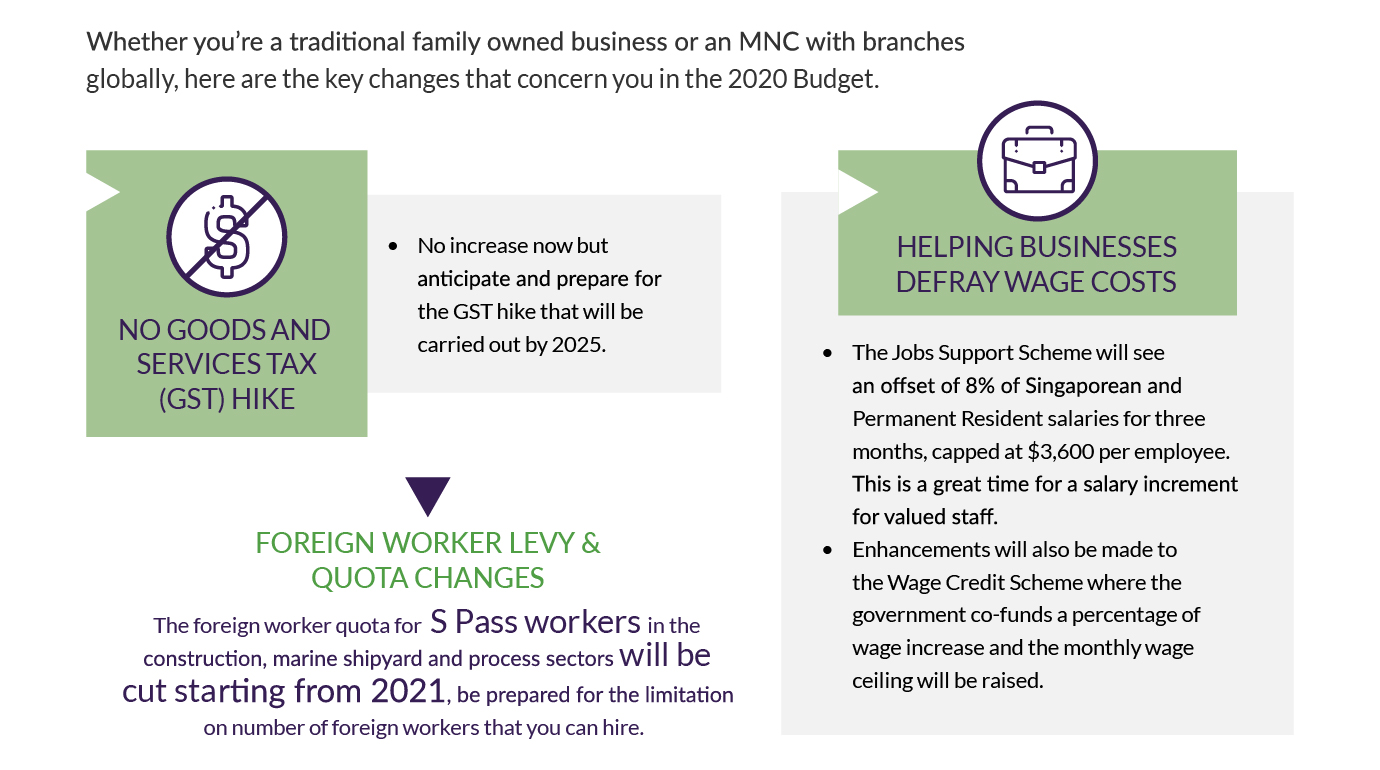
On 18th February 2020, Finance Minister Mr Heng Swee Keat delivered the Singapore 2020 Budget Statement.

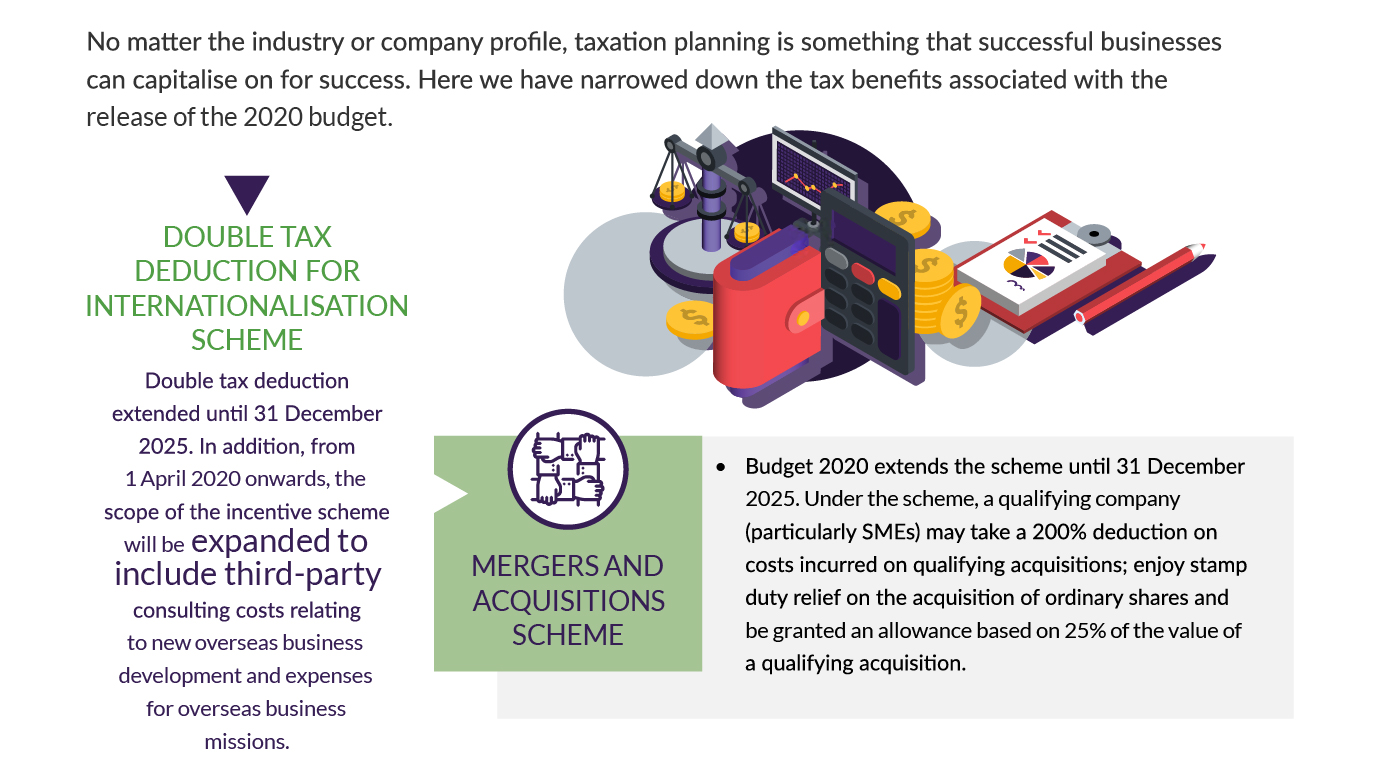
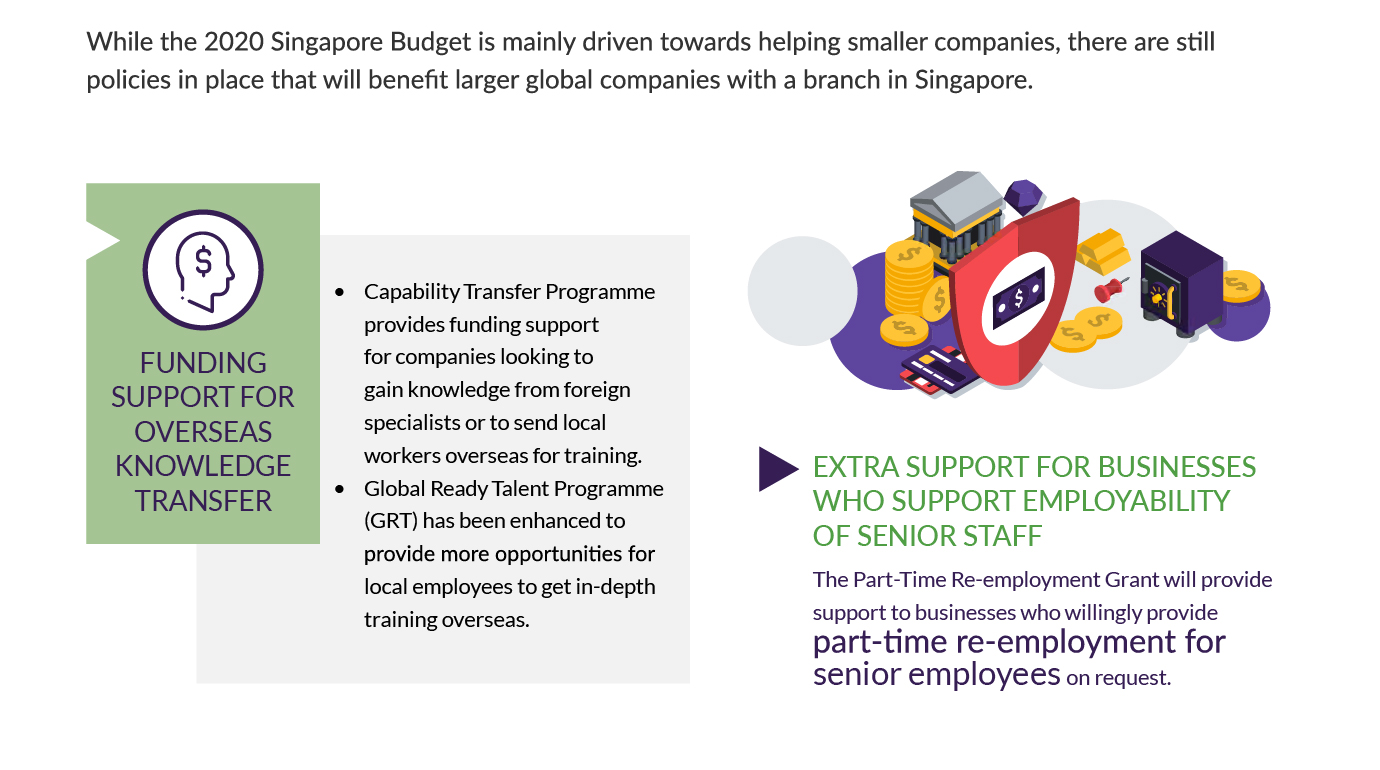
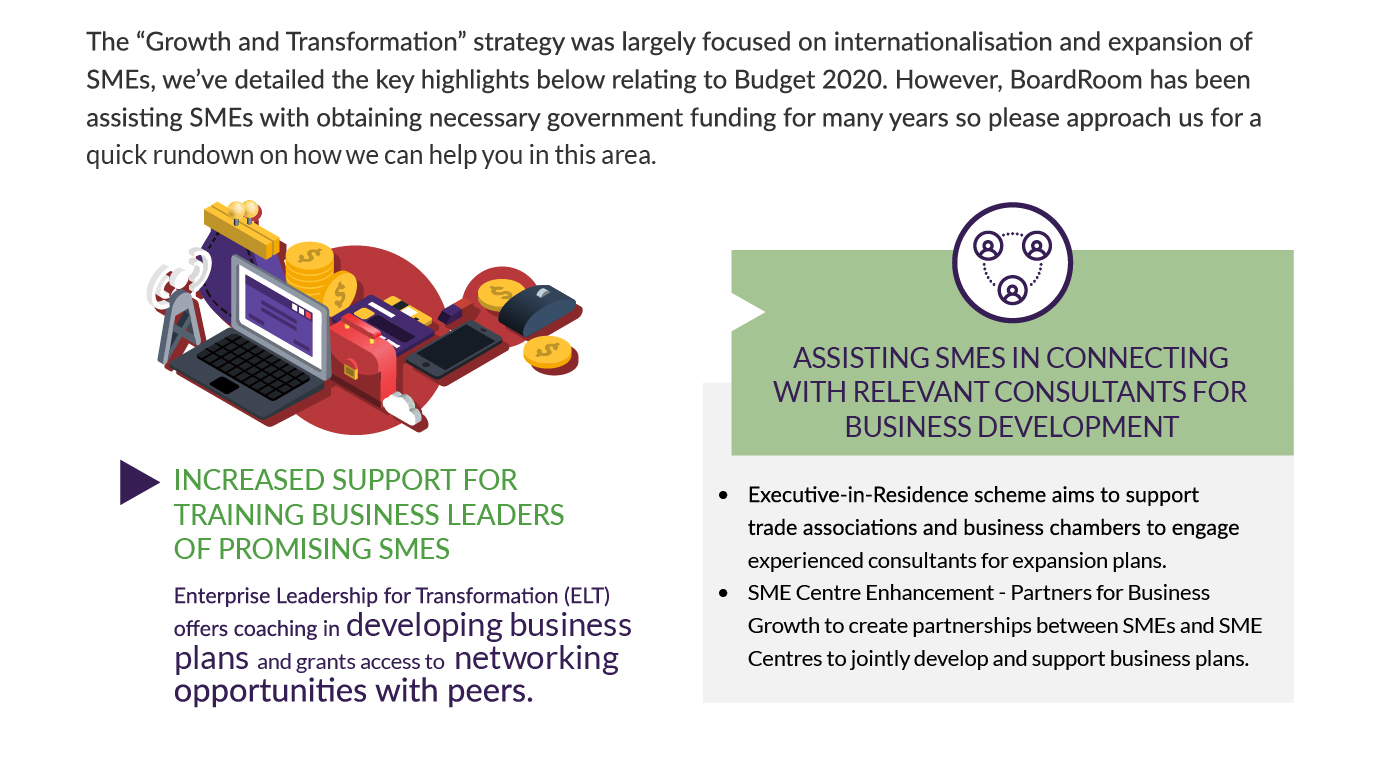
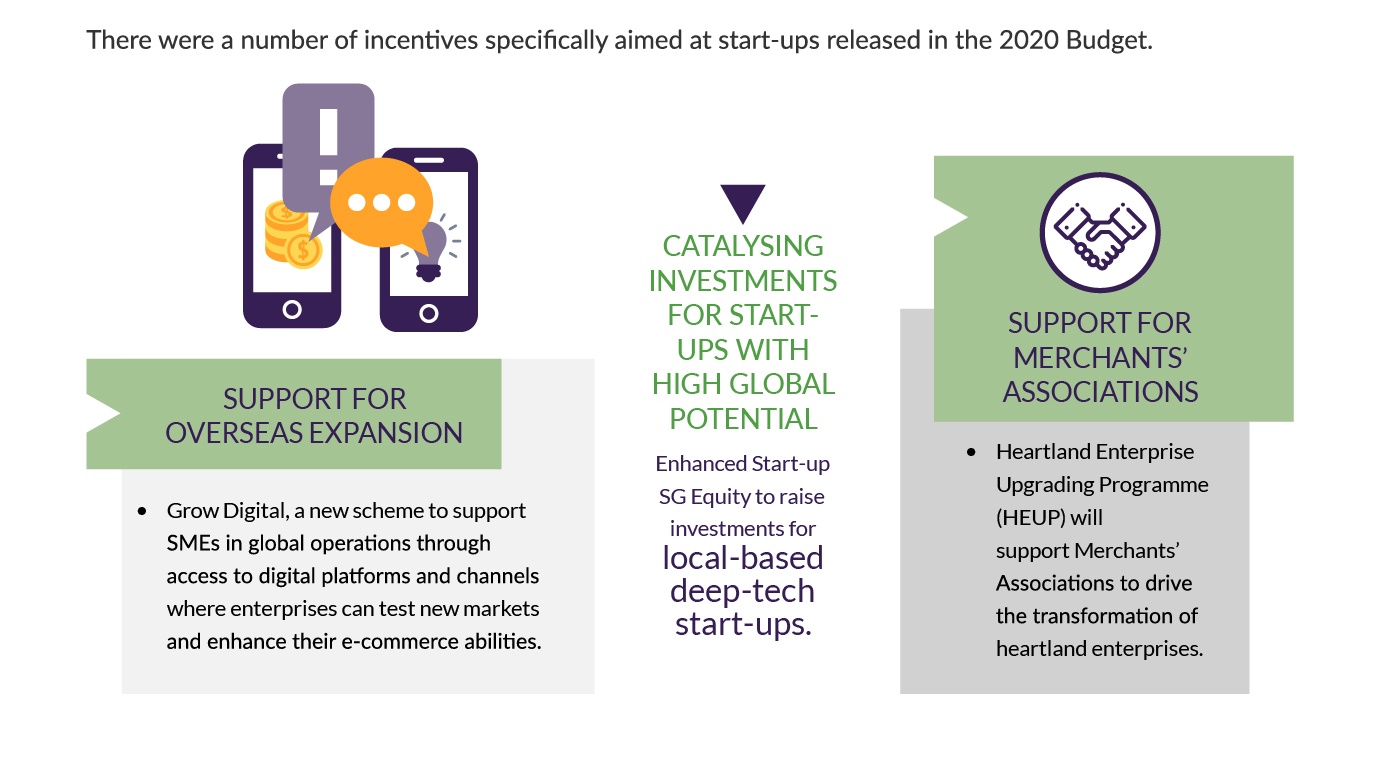
One of the main goals of the strategic financial plan is to grow the economy and transform Singapore’s enterprises through various packages and increased support for businesses, especially those significantly impacted by the COVID-19 virus outbreak. Overall, the Singapore Budget for 2020 aims at long term economic growth through extensive support of SMEs & start-ups. Detailed in this article are some of the changes to take note of and key government initiatives that impact SMEs to listed companies.

If you have any questions relating to any of the information contained in this 16-page infographic report, please contact our tax advisors via email or call us at +65 6230 9788.

What All Enterprises Should Know

Tax Benefits All Enterprises Should Be Aware Of

What MNCs & Listed Companies Should Know

What SMEs Should Know

Useful information for Start-ups

Download the Full 16-page Singapore Budget 2020 Infographic Report

Related Business Insights

Top 5 key benefits of having an Employee Share Option Plan (ESOP)

Top 5 key benefits of having an Employee Share Option Plan (ESOP)

In today’s marketplace, attracting and retaining top talent poses constant challenges. Gone are the days of your traditional 9-5 job and with it your 9-5 employee. Technology has meant we’re now more connected than ever and we are always ‘on’ regardless of whether we’re physically in the office or on holidays. These changes have created a whole new generation of employees that demand more from their organisations and not just in the form of benefits but through an alignment of personal goals and values. This shift in mental state has also created a highly competitive marketplace where retaining top talent is key to a healthy P&L.

Employee Share Plans have long been seen as a way to align your business goals with employee values in addition to driving productivity and aiding retention. In this article we will explore the top 5 benefits of having an Employee Share Plan in place and how it can benefit your business and retain talents within your company.

1. Promotes employee Involvement

The first benefit is perhaps one of the most important but also one of the most misunderstood values of implementing an Employee Share Plan. Simply put, if you align your workforce and your organisation with a common goal it promotes engagement, invites innovation and drives productivity and profitability. All due to ensuring your employees have a sense of ownership. The implementation of an Employee Share Plan ensures that your employees don’t feel like a cog in a machine, but feel they play a fundamental role in business success. That success then becomes tangible when they see the impact to their Employee Share Plan when the company’s stock price improves.

2. Improved recruitment and retention

Companies that adopt an Employee Stock Ownership Plan (“ESOP”) have seen much better retention rates due to the long-term benefits associated with having an ESOP. Employee Stock Ownership Plans provide employees with ownership interest in the company. Typically, the longer they stay with the company the greater the benefits which is why they can be used in the facilitation of succession planning.

ESOPs can often have tax benefits for employees and company alike so are typically implemented as part of a corporate finance strategy. This makes ESOPs a desirable piece of any employee package and as a result aide in retention of employees. In addition to this with the right Employee Stock ownership Plan a business can create desire within top talent, ultimately benefiting your business.

3. Ability to generate liquidity while maintaining control

If you want to generate liquidity for your business but are concerned about losing the operating control that comes along with selling to a third party then an Employee Share Plan might be a viable solution. With an Employee Share plan in place, owners can choose to sell a minority interest, as little as 20 percent, which will generate the liquidity needed.

The benefits associated are not just for the business owner in this scenario, in the case of employees, it enables investment opportunities that might not otherwise have been viable. Many employees do not have the cash to buy shares, a business who implements an Employee Share Plan changes this through the setup of a trust and selling to their employees. Employee’s will then receive shares over time as a retirement benefit.

4. Flexible and tax savings

Employee Share Plans are often used as a part of a corporate finance strategy for their obvious tax deduction benefits. Many regimes around the world today provides a tax-deductible status for company stock contributions, dividends and cash contributions. Their inception was driven by a need to give employees an opportunity to reap rewards from an increase in the value of the company they work for. In doing so, it also encourages loyalty to a company as well as a vested interest in delivering good work which will grow the company.

5. Differentiation from competitors

It is to be expected that a major benefit of having an Employee Share Plan in place long term is the impact on corporate culture. If you have successfully implemented an Employee Share Plan, strategically aligning your employee and shareholder values, you are bound to see dividends in output due to the sense of ownership. All business operations and interactions will be conducted by a team who is engaged and truly cares about the business beyond their personal monthly paycheck.

This shift in mindset will have long term benefits for the company, fundamentally shifting their corporate culture and creating differentiation in the marketplace. Not only will you become a desirable place to work but your productivity, profits and employee engagement will all increase. Over time, this can become a significant competitive advantage.

Looking For A Trusted Employee Share Plan Firm In Singapore?

We have designed an all-rounded encompassing solution comprising of an experienced Share Plan team of practitioners and a digital solution to help you manage your strategic initiative.

01 Learn more about EmployeeServe - our Employee Plan Services platform!

Contact us today to find out more about our class-leading solution.

Or you can also learn more about our Employee Share Option Plan (ESOP) services here.

Related Business Insights

5 Questions To Ask When Choosing Any Corporate Secretarial Services

5 Questions To Ask When Choosing Any Corporate Secretarial Services

When you incorporate a company in Singapore, you are required by the Singapore Companies Act to appoint a corporate secretary within six months from the date of incorporation. The office of the corporate secretary shall not be left vacant for more than 6 months at any one time.

A corporate secretary fulfills a range of compulsory duties including: maintaining company records and statutory registers; arranging board meetings; as well as filing and updating documents with the Accounting and Corporate Regulatory Authority (“ACRA”). As the company grows this role increases in complexity, so while companies may opt to get a director to fulfill this role or to hire an independent corporate secretary, this certainly isn’t the best option.

It is important to realise that the requirements for the corporate secretary of a private company are much simpler than those of a public company. For a private company your corporate secretary simply needs to be an ordinary resident of Singapore and hold the requisite knowledge and experience to fulfil the duties. However, the requirements for the corporate secretary of a public company are much more stringent and complex, which is why a lot of public companies look to outsource this role to a corporate secretarial company.

With such an extensive list of corporate secretarial companies in Singapore, it can be rather hard to decide on the right one to suit your needs. We’ve created this article to show you the 5 key questions to ask when determining the best corporate secretarial services company to outsource to and how to determine the specific services you require.

Question 1: Does The Firm Have Staff That Have The Required Qualifications?

Whether you are a startup or a company looking to go public, it is always wise to engage a company with the best qualifications possible.

In Singapore, a corporate secretary of a public company must be suitably qualified, and satisfy one of the following criteria, at the very minimum:

  • Been a secretary of a company for at least 3 of the 5 years immediately before his/her appointment as secretary of the public company
  • Qualified person under the Legal Profession Act
  • Public Accountant registered under the Accountants Act
  • Member of the Institute of Singapore Chartered Accountants
  • Member of the Chartered Institute of Secretaries Singapore
  • Member of the Association of International Accountants (Singapore Branch)
  • Member of the Institute of Company Accountants, Singapore

If the company you are considering has staff who can meet all these requirements, then you can be assured it is fully capable of handling the corporate secretarial services of both public and private firms.

Question 2: Do They Understand All The Local Rules And Regulations?

It is especially important to choose a reputable secretarial services firm that is aware of all the local rules and regulations, including any extensions or modifications.

They have to be able to handle the arrangement of AGMs, tax filing as well as the maintenance and filing of company records within the time stipulated by the authorities. Further to this, a great secretarial services provider should ensure that your business is well organised and in effect ensuring you save costs in the long run.

The final piece to consider when asking this question is in relation to international law. If your company operates internationally your company secretary will need to have knowledge of the local laws in different countries which may affect local proceedings, not just your domicile region. International law is vastly complex with rules about taxes, trade, currency conversion, and that contracts vary from region to region so it’s important you ask this question when considering not only the company but also the services you require for your corporate secretary.

Question 3: Do They Provide A Comprehensive Suite Of Solutions?

As your business grows, it can be beneficial to outsource the non-core functions to a single provider so your time and resources are free to focus on core functions and strategic opportunities. Non-core functions include: financial accounting (recording and preparing the income statement, the balance sheet and the statement of cash flows); tax filing; and company payroll (processing payment instructions, generating salaries and statutory reports, filing bank payments, and creating electronic pay slips).

Having all these services under one roof makes it easier for you in the short term as you don’t need to spend time hunting for individual providers, but also in the long term with the efficiencies created through having a single provider manage your non-core business operations.

Moreover, it is likely that your provider will be able to customise a specific package which encompasses all your business needs, allowing you to also enjoy significant cost savings.

Question 4: Does Your Firm Provide A Dedicated Corporate Secretary Or Account Manager For Your Company?

Having a single point of contact allows for excellent communication. Such an individual will be familiar with the history and operations of your company.

This allows for a long-term partnership and for your corporate secretary to grow with your business, providing personalised customer care.

There is a specific time-frame during which annual returns should be filed, and an Annual General Meeting should be held. Having a dedicated corporate secretary will ensure that all these details will be attended to promptly as non-compliance of any of these regulations could result in penalties.

Question 5: Am I About Go Public With My Company Or Am I Evolving My Corporate Structure?

As with any decision, you need to think about the future of your business and what direction you’re heading. If you’re considering going public or even evolving your corporate structure you will need a firm that goes beyond providing the basic corporate secretarial services. You’ll have to look for a provider that has a track record of handling not only regional but also multinational firms.

In addition to this, you will need to consider the services you may require pending the direction your company takes. As an example this could include any, or even all, of the following services: compliance; employee care; expansion (expat services and payroll); employee plan services; and shareholder support services like poll-voting and share registry.

If you are considering taking your company public there are further considerations required for the setup process, enlisting the support of a secretarial firm to manage this can ensure they manage the gruelling administrative work, saving you time and guaranteeing the process runs as smoothly as possible.

Looking For Corporate Secretarial Services In Singapore?

At BoardRoom, we are a top corporate services firm in Singapore with a 50 + year track record of success serving over 7,300 clients regionally. We are experts in helping companies, from multinational corporations to fast-growing SMEs, allowing them to focus on what matters – growing their business. From handling tax accounting to managing secretarial duties for companies across Asia-Pacific, our full suite of corporate services allow our clients to stay compliant, maximise savings and stay organised for better decision making.

Contact us today and empower your organisation with greater freedom through our range of corporate solutions.

Or you can also learn more about our corporate secretarial solutions here.

Related Business Insights

State of the Market: Singapore (2019) AGM Landscape Trends Report

State of the Market: Singapore (2019) AGM Landscape Trends Report

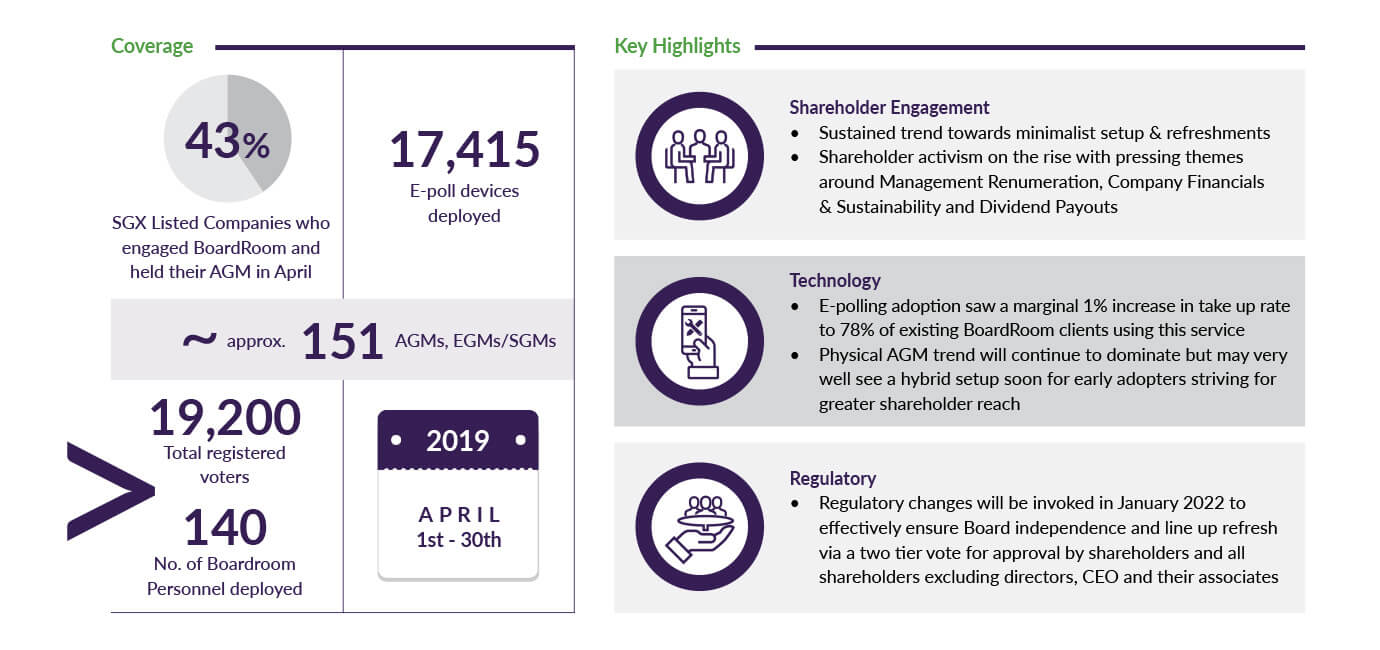
Delivering 151 meetings across the month of April, our dedicated Share Registry team had access to more meeting data than any other organisation in Singapore. This report delivers key insights into the current state of the AGM market, the impact of technology and regulation changes as well as prevailing trends in a digestible 10-page report.

BoardRoom First Annual AGM Thought Leadership Paper FY2019

In FY2019, our dedicated Share Registry Team successfully delivered 151 meetings in Singapore notably for the April peak season, including AGMs, General and Scheme meetings. As a market leader in the Meeting Services space today, we have significant access to more meeting data than any other organisation in Singapore, which offers the opportunity to provide an in depth analysis of AGM activities, combining detailed voting and attendance outcomes across SGX listed entities.

This paper aims to deliver insights by decoding the following key questions:

  1. What are some of the prevailing trends at AGMs today?
  2. How is technology impacting the way we deliver our AGMs today?
  3. How is the evolving regulation and its landscape shaping our AGM environment today?
About the Data

This section sets out the breadth and scope of our paper. The insights and analysis provided here were acquired through BoardRoom’s coverage of our clients where we provided AGM meetings and Electronic Polling services.

AGM Key Highlights
AGM Logistics

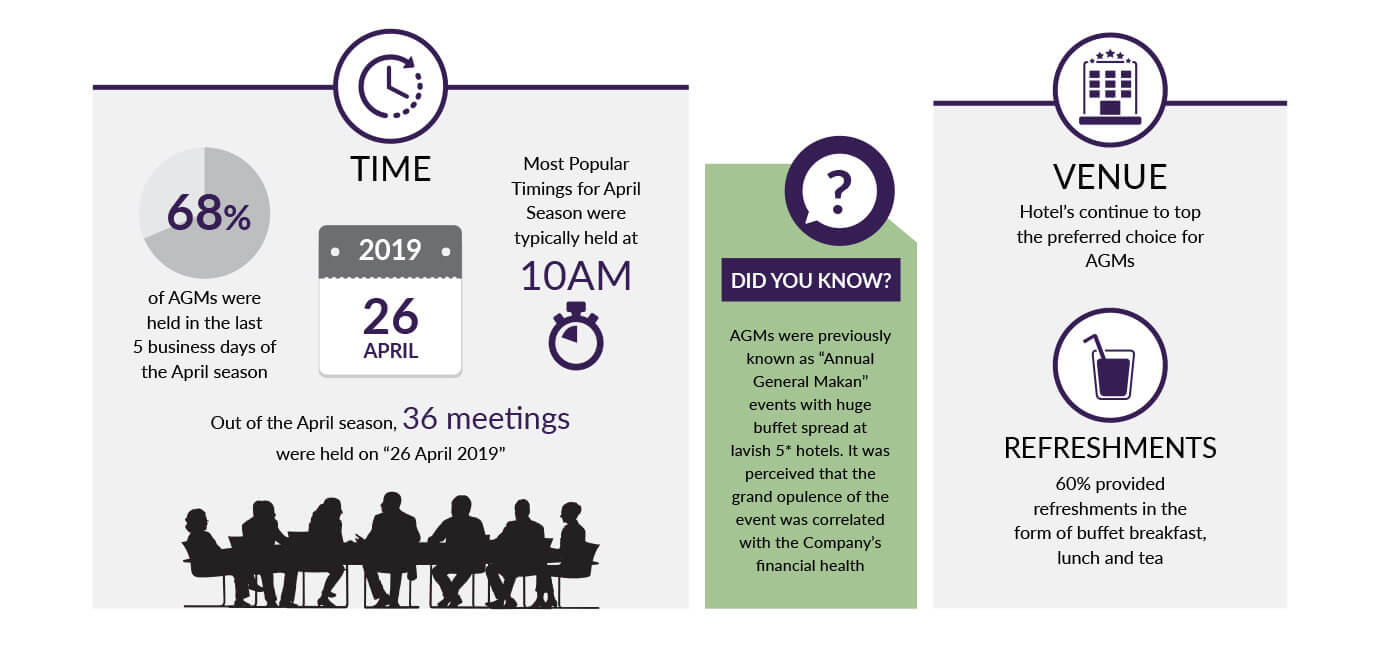
Logistics continue to be a key consideration when it comes to AGMs today. The needs and requirements largely vary across different companies but still driven by expected interest in attendance by shareholders and the Board of Directors (“BOD”) attitude towards its AGM as a communication event. Hotel’s continue to be the preferred choice of venue for the majority of companies to enable the facilitation of large shareholder crowds. However, we have observed an emerging trend towards simple venue layouts with minimal refreshments to ensure full participation and engagement on pertinent issues.

AGM Logistics
AGM Shareholder Engagement

Download the Full Singapore (2019) AGM Landscape Trends Report

Related Business Insights

Interview Series: A Day In The Life of a Share Registry Officer

Interview Series: A Day In The Life of a Share Registry Officer

Interview Series

A Day In The Life of an SRO

1. Describe myself in a sentence or collection of words?

I’m a small-town boy, who is sport obsessed, a proud Manchester United fan, avid sneakerhead aka collector with an undeniable sweet tooth and Netflix and chill is life.


2. What’s your best dad joke?

What do you call an elephant that doesn’t matter? Irrelephant. (Full disclosure, I had to Google this lol)


3. How do you explain to people what you do?

I’d say that I work in a very niche service role that not a lot of people know. Basically, I do client servicing for listed and un-listed companies. They could be publicly listed on the Singapore Stock Exchange or elsewhere. From a client servicing standpoint, I do a whole range of things but one of which is answering shareholder enquires – as an example someone has enquired about any upcoming meetings or dividends (money issued to shareholders), or a change in the shareholders particulars e.g. name, address etc.


4. Walk me through a typical day in the office at Boardroom.

I usually get to the office around 8am or 8:15am (I know it sounds early!) but I like to have my breakfast here (honeydew melon, 2 pieces every day), and read the news, basically ease into my day. Then I’d start my work, clearing emails transferring of shares, issuing of cheques to shareholders. I also work with someone on my team to help the newcomers with training each day. At about 11:00 or 11:30 (to beat the Raffles rush!) we usually go out for lunch, there’s loads around thankfully as we’re a bit too lazy to walk too far 😉 after lunch I continue with my work and also train new team members. Then late in the afternoon I’ll plan for the following day or any peak upcoming meeting seasons.


5. What’s your favourite element of the job?

There’s two elements to this for me, the professional piece and the personal. I’ll start with the professional which would be the completion of a successful meeting. It’s difficult to describe the sense of accomplishment when you’re involved in the whole process and the meeting goes off without a hitch and you have a very happy client. I just feel a huge sense of achievement. The other element that I love about my job is the people – they’re awesome! Especially in Share Reg, I don’t see them as colleagues, I genuinely see them as friends. We hang out during work, after work and on the weekends!


6. Did you know what an AGM was before you started work here?

I was aware of the term, but I had no real idea of what the proceedings were and what the purpose was.


7. What are you looking forward to right now?

Pay day! Kidding (sort of haha). In all seriousness, meeting my clients. Our clients typically have their meetings once a year, so I love putting a face to the name I’ve been seeing in my inbox all year!


8. What was your first AGM experience like?

I was soo nervous, especially because this happened in my first few days on the job! I was part of the registration team, it felt very formal, but I had a very supportive senior manager who walked me through the entire process. It made me feel more relaxed and settle into the job. Once the meeting started I went into the meeting room to take down questions, it was a bit daunting at first as there was a lot of technical terms flying around where shareholders were quizzing the board on decisions but I feel that overall it was an awesome experience sitting inside the meeting as it gave me a great overview of the company, how they’re doing and where they’re headed.


9. Why do you love working with your team?

They’re all a friendly and fun bunch of people. Plus, my manager is super knowledgeable and supportive, I’ve learnt a lot from her.


10. What’s your biggest takeaway from your experience here at Boardroom Share Registry Services?

Our clients that we deal with are all high-level management, as a result I’ve learnt best-practicing client servicing such as speaking professionally, managing expectations and building relationships. I’ve also learnt a lot about the industry. Most importantly, I’ve made some lifelong friends – everyone in the team is around my age and we all just get along so well.

1. Describe myself in a sentence or collection of words?

I’m a massive foodie, friendly, outgoing, I could talk to people all day, easily adaptable, very organised except for at home with my clothes, I love travelling for the food and people. I listen to all types of music and am definitely prefer dogs to cats


2. What’s your best dad joke?

Ok I’ve got one – what do you call it when a short person waves? A microWAVE! Get it??


3. How do you explain to people what you do?

It’s very difficult to explain, I usually start off with I’m a Share Registry Officer and end at Client Services Officer, which certainly doesn’t do justice to the job but it’s really hard to explain to people, especially if they themselves don’t invest as they don’t understand the language we use or the parties we work with like SGX.


4. Walk me through a typical day in the office at Boardroom.

A day in BoardRoom varies according to the month we’re in. So, in April you walk into the office and it will be empty as we’re all out for AGMs during the day but at night the office will be filled with people as we’re all back preparing for the next day’s AGM. It’s such a crazy month! Then on the months with distribution (about 4 months), we’re busy with tax declaration forms and preparing of cheques, it’s a fun time because we all sit around opening mail together laughing and chatting. In December we enjoy taking long lunches and feasting on the Christmas buffets, so we take a breather and reset for the next year. We also get a lot of gifts from clients during this time of the year like hampers and cookies.


5. What’s your favourite element of the job?

Definitely gaining new knowledge every day. For me it’s always interesting because for every client the corporate action is completely different, so as a result I learn a lot of stuff that I would never have learnt if it weren’t for the role I’m in. You learn soo much here! Sometimes I think it’s too much for my brain


6. Did you know what an AGM was before you started work here?

No, not really. Fun fact, I actually started out here as a temp staff to just help out with the AGMs, I’d just graduated from school and I had no idea what AGM, financial year-end, etc meant! I’ve come a long way since then!


7. What are you looking forward to right now?

I’m looking forward to my next lunch buffet! Kidding! There is one of our clients who always put on the BEST spread at their AGMs. I look forward to it every year and the team always fights over who gets to attend. And sometimes seeing and meeting cute guys aka young lawyers!


8. What was your first AGM experience like?

Oh my gosh, that was 5 years ago so I barely remember! There was no polling then, so it was a little simpler than today. My first experience when I was fronting the AGM, i.e. when you need to read the procedures was quite nerve-wracking as everyone is staring at you, the Chairman, the Board, the Shareholders. But it’s a huge sense of accomplishment when everything goes smoothly.


9. Why do you love working with your team?

My team is awesome!! For me I think I have great managers and colleagues that always help one another. There’s a real ‘no man left behind’ mentality so we share everything 😊 and we laugh a lot! We’re like a family, we hang out outside of work and have gone on trips together. Working here has really bonded us.


10. What’s your biggest takeaway from your experience here at Boardroom Share Registry Services?

There’re too many things! I’ve learnt how to be calm under pressure. To also be able to adapt in a lot of different scenarios and deal with things professionally. I’ve made a lot of connections too. Sorry! I can’t just limit it to one!

1. Describe myself in a sentence or collection of words?

I come from the city of smiles, am coffee and rice obsessed, a sunset chaser and dog lover with a weird obsession for gory shows (Game of Thrones anyone?). I love my friends, but I also love ‘me time’. Oh, and most importantly I’m a karaoke tragic and can sing Mariah Carey until the sun rises!


2. What’s your best dad joke?

My dad is actually very funny, and this is his joke that I can never forget…
One day he told us what our baby’s name should be based on a combination of our partners’ name and our name! Some of them were hilarious!

So, for my sister Hannah whose boyfriend was Robel; their baby should be named Harob. For my sister Nissi who’s boyfriend was Paul – the baby’s name should be Nipaul (haha). And mine was the least ugly, I was with this guy named Carlo, and he said our baby should be named Loren (not so bad right haha)


3. How do you explain to people what you do?

To be honest I’m really struggling with explaining to people what I do because people don’t know what Share Registry is so most of the time I tell them I do an operational job in this company called BoardRoom. If they want to know more, I will then explain what BoardRoom does and say as an example if a company wanted to list on the Singapore Stock Exchange they would need to approach a Share Registrar to manage their shares, that’s where we come in. I would then say day to day we process tax forms for clients so that their investors won’t be taxed internationally. Amongst other things of course.


4. Walk me through a typical day in the office at Boardroom.

I’m a sunset chaser who struggles to wake with the sun. When I get into the office I start by checking emails and thinking about when I can go and get a coffee. (lol) After that I spend a lot of time completing tax forms, replying to emails, answering phone calls. I usually go out for lunch with a few of my team around 11:30 (we don’t really eat breakfast so are starving by this time!) we usually to a great local Indian restaurant. I then go back to the office and drink a lot of tea and continue with any ad-hoc requirements or jobs that are outstanding from the morning. I’m also studying part-time, so I usually have classes after work.


5. What’s your favourite element of the job?

I actually work really closely with senior staff in the company assisting their projects. I take a huge amount of pride in what I do and ensuring I’ve done a good job, so I love when I am recognised for that.


6. Did you know what an AGM was before you started work here?

I had no idea what an AGM was before I started here! My background before this was customer relations in a hotel so this is a whole new world for me!


7. What are you looking forward to right now?

I’m really looking forward to finishing my studies, it’s just around the corner. From a working standpoint, we’ve just had a new boss come in so I’m excited to get to know him and see how the team and my career develops under his management, especially once I finish my studies.


8. What was your first AGM experience like?

I started working at BoardRoom at the end of September and October is a peak season for AGMs so on my second week I attended my first AGM and helped with registration. I was worried about wanting to look professional and ensure I could answer client questions, but the team was really supportive and assured me that I wouldn’t be put on the spot like that and to just watch and learn which made me feel really comforted. It was a great learning experience seeing the teamwork through the AGM and interact with clients.


9. Why do you love working with your team?

We really treat everyone as a family and not just my team but the wider Share Registry team. We’re always happy to help one another out no matter how busy we all are. I genuinely feel like we’re all part of a family.


10. What’s your biggest takeaway from your experience here at Boardroom Share Registry Services?

Working here has really built my confidence because the team is so supportive and encouraging. In addition to this, I can see how much I’ve learnt since starting here and this continues every day, so it makes me feel like I’m continually growing and developing in myself.

1. Describe myself in a sentence or collection of words?

I’m all about a slow pace of life, brunches, binge-watching Korean drama & Marvel movies on Netflix (yep my tastes are diverse)! I love travelling, mostly to Australia as they’re just so chill! I also have an upcoming epic collection of statues and figurines, the biggest addition to my collection will be Optimus Prime!


2. What’s your best dad joke?

I don’t really have one, as I’m not good at remembering jokes sorry! I’m sure I’ve heard some good ones though.


3. How do you explain to people what you do?

It’s tough as most people don’t really understand what we do unless they are very into the stock market. So, I basically say that we help listed companies on SGX with things like corporate action (share transfer etc.) and help clients to manage and plan for their general meetings (AGM, SGM, EGM etc.).


4. Walk me through a typical day in the office at Boardroom.

For the most part I spend my days checking emails, replying to shareholder queries and calls with my clients. There’s also a lot of ad hoc activities to do so it’s a good change of pace and keeps things interesting. For me the best part of my days are the people I work with. We have such a great team and spend a lot of time together, sometimes too much time when I think about some of the conversations we’ve had over lunch, nothing is off-limits, including bowel movements and bad dates! haha


5. What’s your favourite element of the job?

Even though we work in an office job there are times where we are able to leave the office for AGMs and site visits which are really exciting and different.


6. Did you know what an AGM was before you started work here?

I only had a vague idea of what an AGM was i.e. it was an annual meeting with shareholders, but I had no idea what was discussed and how they work.


7. What are you looking forward to right now?

5:30? (haha, kidding!) I have an AGM coming up tomorrow so I’m looking forward to that.


8. What was your first AGM experience like?

Slightly nerve-wracking as I was afraid I wouldn’t be able to register shareholders properly. My first AGM was a big one and I was actually supporting another team who were really busy. The team I was assisting were so helpful and really supportive as they knew it was my first time – the teamed me up with a buddy who was able to assist me and help with my confidence on the day.


9. Why do you love working with your team?

They’re fun, young, helpful and energetic.


10. What’s your biggest takeaway from your experience here at Boardroom Share Registry Services?

I’ve been able to learn more about how the stock market and listing company works, I’ve actually found it to be really interesting – more than I originally expected which has been great!

Looking For Share Registry & Meeting Services In Singapore?

BoardRoom is the market leader in share registry services, helping to guide companies through their IPOs, from executing shareholder meetings, running proxy votes, scrutineering to serving as a share registrar.

With a 50 + year track record of success serving over 7,300 clients regionally, we are the experts in helping companies, from multinational corporations to fast-growing SMEs, allowing them to focus on what matters – growing their business.

Contact us today and empower your organisation with our range of corporate solutions.

Or you can also learn more about our share registry and meeting solutions here.

Related Business Insights